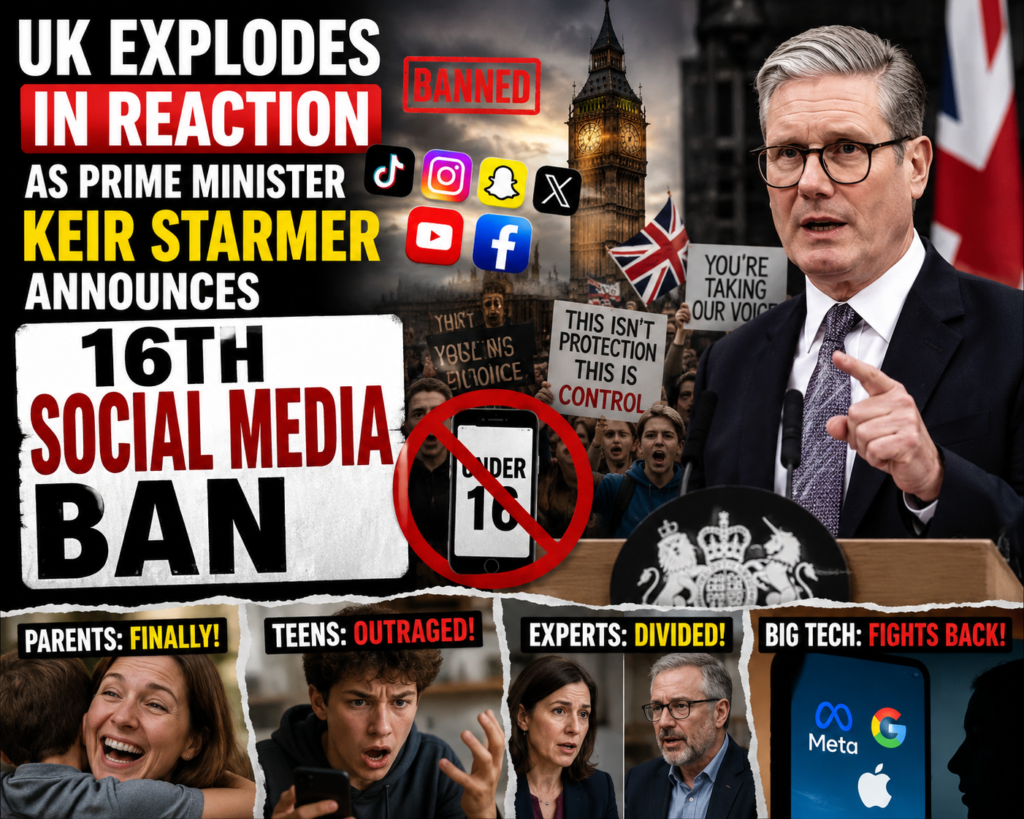
The United Kingdom has been thrown into a digital-age shockwave after Prime Minister Keir Starmer unveiled one of the most controversial child safety policies in modern political history: a nationwide ban on social media for anyone under the age of 16.
The announcement, delivered from Downing Street, has instantly triggered outrage, celebration, confusion, and intense debate across the country. Within minutes of the news breaking, social media itself — ironically — became flooded with reactions from stunned parents, furious teenagers, and divided experts all asking the same question: “Is this really happening?”
A historic crackdown on the digital generation
Under the new policy, platforms such as TikTok, Instagram, Facebook, Snapchat, X (formerly Twitter), YouTube, and Reddit will be off-limits to under-16s in the UK.
The government says the move is designed to protect children from harmful content, cyberbullying, addictive algorithms, and mental health risks linked to excessive screen time. Starmer described the current online environment as a system “failing our kids,” arguing that stronger action was now unavoidable.
“This is about giving children their childhood back,” he reportedly told reporters, framing the decision as a moral necessity rather than a technological restriction.
But critics say it is one of the most sweeping internet controls ever attempted in a Western democracy.
“I didn’t know he was going that far”
Public reaction has been immediate — and explosive.
Parents across the UK have largely welcomed the announcement, with many saying they feel “relieved” that the government is stepping in where tech companies have failed. Campaign groups supporting child safety online have also praised the move, calling it a “long-overdue intervention.”
However, teenagers have reacted very differently.
On platforms like TikTok (ironically still active during the announcement), users posted emotional videos ranging from disbelief to anger. One viral sentiment summed up the mood: “We grew up online — now they’re just switching it off.”
Others questioned how enforcement would even work, pointing to VPNs, fake ages, and alternative apps that could easily bypass restrictions.
Experts are also split. Some argue the ban could reduce exposure to harmful content, while others warn it may push young users into less regulated corners of the internet, potentially making the problem worse rather than better.
What exactly will change?
According to government briefings, the policy goes beyond a simple “block.”
Under-16s will be prevented from creating accounts or accessing major social media platforms altogether. Messaging services like WhatsApp and Signal are expected to remain accessible, but with stricter protections.
Additional restrictions are also being considered for older teenagers aged 16–17, including limits on late-night scrolling, tighter content controls, and possible restrictions on AI chatbot interactions designed to mimic romantic or emotional relationships.
Gaming platforms are also under scrutiny, particularly features that allow private messaging or interaction with strangers.
In short: this is not just a ban — it is a full redesign of how teenagers experience the internet.
Why now? The political pressure behind the move
While the announcement may seem sudden, insiders suggest the policy has been building for months behind the scenes.
A major government consultation reportedly showed overwhelming parental support for stricter rules, with around nine in ten respondents backing a minimum age limit for social media access.
Pressure from campaign groups, grieving families affected by online harm, and growing political competition over child safety has pushed the issue to the top of the national agenda.
There is also international influence. Australia recently implemented similar restrictions for under-16s, and the UK’s approach appears to go even further — hence the term now being used in media reports: “Australia plus.”
Big Tech fights back
Unsurprisingly, the world’s largest tech companies are not happy.
Meta, which owns Facebook and Instagram, has warned that blanket bans could isolate teenagers socially and push them toward unregulated platforms with fewer safety features. YouTube and Snapchat echoed similar concerns, arguing that supervised access is safer than total exclusion.
Tech industry voices say the policy could backfire, creating a “digital underground” where age checks are bypassed and harmful content is harder to monitor.
But government officials insist the responsibility has been ignored for too long — and that companies must now adapt.
Experts warn of “unintended consequences”
Child safety organisations are divided.
Some, like advocacy groups linked to online harm prevention, say the ban could reduce exposure to toxic content and improve mental well-being.
Others warn it risks oversimplifying a complex problem. They argue that social media itself is not the only issue — algorithm design, lack of regulation, and weak enforcement are the real drivers of harm.
One concern repeatedly raised is enforcement: how will platforms reliably verify age without creating privacy risks or forcing children into identity systems that could be exploited?
A cultural turning point
Whether you see it as protection or restriction, one thing is clear: this policy marks a turning point in how the UK views childhood and technology.
For the first time, an entire generation may be formally separated from mainstream social media until their mid-teens — something unthinkable just a decade ago.
Supporters say it restores balance in a digital world that has moved too fast for children to safely adapt. Critics say it risks isolating young people from the very spaces where modern life happens.
What happens next?
The government is expected to outline implementation timelines in the coming months, with enforcement measures likely involving stricter age verification systems and fines for non-compliant platforms.
For now, though, the country remains locked in debate.
And as one viral post put it perfectly:
“We used to worry about kids spending too much time online… now they might not be allowed online at all.”