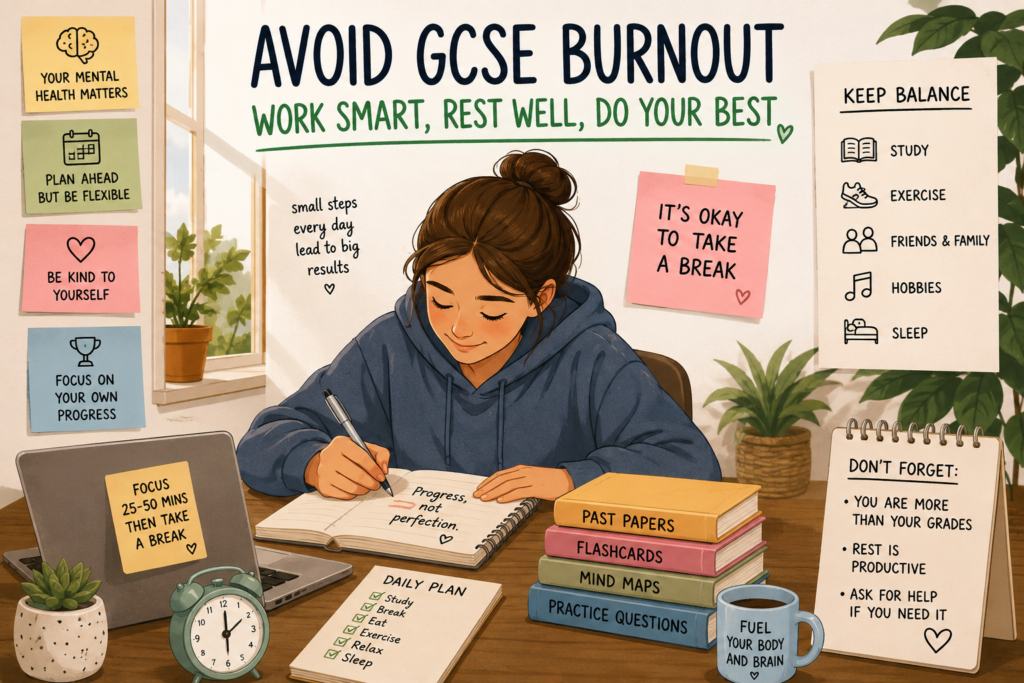
Somewhere between revision timetables, endless past papers, and the pressure to “just get top grades,” a quiet crisis has been building in schools: GCSE burnout. It’s that drained, foggy, emotionally flat feeling where students don’t just feel tired—they feel done.
And the worst part? It usually doesn’t happen overnight. It creeps in slowly, disguised as “working hard.”
So how do future students avoid getting to that point in the first place? Let’s break it down in a real, practical way.
What GCSE Burnout Actually Feels Like
Burnout isn’t just being stressed before exams. It’s when stress becomes constant and starts to wear you down mentally and physically.
Students often describe it like:
“I open my books and nothing goes in.”
“I’m always tired, even after sleeping.”
“I feel guilty when I rest, but I can’t focus when I study.”
It’s not laziness. It’s overload.
And GCSEs, with multiple subjects, pressure from school, expectations from family, and social media comparisons, can easily tip students into that zone.
1. Stop Treating Revision Like a Marathon of Suffering
A big mistake students make is believing that “more hours = better results.” That’s not how the brain works.
The brain learns in cycles, not marathons. After about 45–60 minutes of focused work, attention drops sharply. Pushing beyond that doesn’t equal progress—it often equals burnout.
A smarter approach is:
Study in short focused blocks (25–50 minutes)
Take real breaks (not just scrolling TikTok in stress mode)
Stop before you’re completely exhausted
Think of revision like training for sport, not punishment for exams.
2. Build a Timetable That Breathes, Not One That Suffocates
A lot of revision timetables look like prison schedules: every hour packed, no space to breathe.
That kind of structure usually collapses within a week.
Instead, future students should build flexible timetables with:
Buffer days (catch-up time)
Light study days
Proper rest days
Space for unexpected school workload
A good timetable doesn’t control your life—it supports it.
3. Learn to Rest Without Guilt
One of the biggest hidden causes of burnout is guilt during rest.
Students often think:
“If I’m resting, I’m falling behind.”
But rest is not the opposite of revision—it’s part of it.
Your brain consolidates memory during downtime. Sleep, breaks, and even boredom help learning stick.
So yes:
Watching a series
Going outside
Sleeping properly
is not “wasting time.” It’s recovery.
Without it, revision becomes less effective anyway.
4. Mix Study Methods So Your Brain Doesn’t Switch Off
If revision feels boring all the time, burnout comes faster.
The solution is variety:
Flashcards for memory
Practice questions for exam technique
Teaching someone else
Mind maps for big topics
Past papers under timed conditions
Switching methods keeps your brain engaged instead of slipping into autopilot fatigue.
5. Reduce “Comparison Pressure” (This One Is Huge)
A lot of GCSE stress doesn’t come from work—it comes from watching other people work.
Seeing classmates say “I’ve done 10 hours today” or “I finished the syllabus already” can quietly create panic.
But here’s the truth: everyone revises differently, and a lot of online study culture is exaggerated anyway.
Future students should focus on:
Their own progress
Their weak areas
Their own pace
Not someone else’s highlight reel.
6. Keep Life Outside Exams Alive
When GCSEs start, many students unintentionally shrink their entire life down to revision only.
That’s dangerous.
Burnout is more likely when:
You stop seeing friends completely
You drop hobbies entirely
Every conversation becomes about exams
Even during intense revision periods, students should keep at least one “non-academic anchor,” like:
Music
Sport
Art
Gaming
Family time
It keeps identity intact beyond grades.
7. Spot Early Warning Signs Before It Gets Serious
Burnout doesn’t suddenly appear—it signals first.
Watch out for:
Constant procrastination despite pressure
Feeling emotionally flat about results
Frequent headaches or fatigue
Irritation or anxiety about studying
“I don’t care anymore” thoughts
If these show up, it’s not a sign to push harder—it’s a sign to adjust pace.
8. Schools and Parents Matter Too
Preventing GCSE burnout isn’t only on students. Schools and families play a role.
Supportive environments:
Encourage balanced study habits
Don’t glorify overworking
Recognise effort, not just results
Teach exam strategy, not just content
When pressure becomes constant from every direction, burnout becomes much more likely.
Final Thoughts: GCSEs Are Important, But They’re Not Everything
Here’s the truth students often don’t hear enough: GCSEs matter, but they are not meant to break you.
They’re designed to measure learning—not mental exhaustion.
Future students who learn early how to balance work, rest, and mindset will not only perform better—they’ll actually survive the process with their confidence intact.
Because the real goal isn’t just passing exams.
It’s getting through them without losing yourself in the process.
