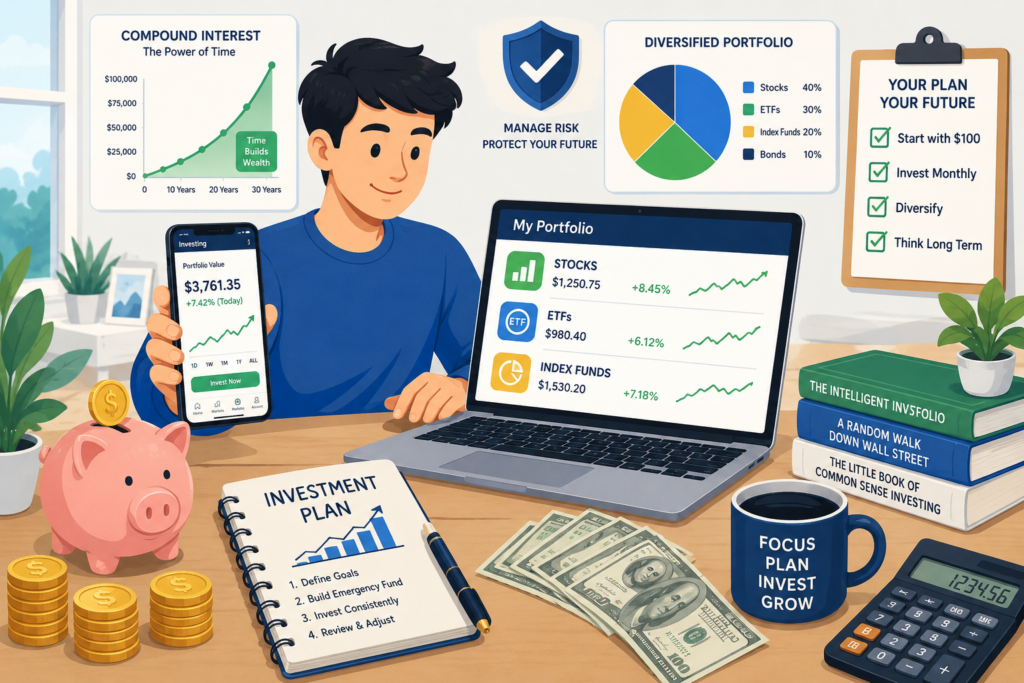
How to Start Investing for Beginners (Even With Just $100)
How to Start Investing for Beginners (Even With Just $100): A Complete Step-by-Step Guide
Learn how to start investing for beginners with just $100. Discover stocks, ETFs, index funds, compound interest, risk tolerance, common investing mistakes, and practical tips to build long-term wealth.
Imagine planting a tiny seed in your backyard. At first, it doesn’t look like much. Weeks go by, and you barely notice any change. But as months turn into years, that small seed grows into a strong tree that provides shade, fruit, and lasting value.
Investing works in much the same way.
Many people believe they need thousands of dollars before they can start investing. Others think investing is only for wealthy individuals, financial experts, or people working on Wall Street. These misconceptions stop millions of people from building wealth.
The truth is much more encouraging.
Today, thanks to online brokerage platforms and investment apps, you can begin investing with as little as $100. In some cases, you can even start with less by purchasing fractional shares of stocks or investing in diversified funds.
The amount you start with isn’t nearly as important as starting early and investing consistently.
Every dollar you invest has the potential to grow over time through market gains and the incredible power of compound interest. While there are no guarantees in investing, history has shown that long-term investors who stay disciplined have often been rewarded with significant wealth growth.
Whether your goal is retiring comfortably, buying your dream home, funding your children’s education, or simply making your money work harder than it does in a savings account, learning how to invest is one of the most valuable financial skills you can develop.
This beginner-friendly guide will walk you through everything you need to know, from understanding stocks and ETFs to choosing investments that match your goals and avoiding common mistakes. By the end of this article, you’ll have the confidence to take your first step into the world of investing—even if all you have is $100.
Table of Contents
- What Is Investing?
- Why Should You Start Investing Early?
- Can You Really Start Investing With Just $100?
- Understanding Stocks
- What Are ETFs?
- What Are Index Funds?
- Stocks vs ETFs vs Index Funds
- The Power of Compound Interest
- Understanding Your Risk Tolerance
- How to Start Investing Step by Step
- Common Investing Mistakes Beginners Make
- Actionable Tips for Beginner Investors
- Real-World Examples
- Frequently Asked Questions
- Conclusion
- SEO Title
- Meta Description
- Image Prompt
What Is Investing?
Investing is the process of putting your money into assets that have the potential to increase in value over time.
Instead of allowing your money to sit idle in a regular savings account, investing gives it an opportunity to generate returns through capital appreciation, dividends, or interest.
Think of investing as hiring your money to work for you.
When you earn money from your job, you exchange your time for income. Investing allows your money to continue working even when you’re sleeping, traveling, or spending time with family.
Although investing comes with some level of risk, it has historically provided much higher long-term returns than simply saving money in a traditional bank account.
Saving vs Investing
Many beginners confuse saving with investing. While both are important, they serve different financial purposes.
| Saving | Investing |
| Keeps your money safe | Helps your money grow over time |
| Low risk | Moderate to higher risk |
| Lower returns | Higher long-term growth potential |
| Best for short-term goals | Best for long-term goals |
| Easy access to cash | Value may rise and fall |
For example, if you plan to buy a new smartphone in six months, saving is usually the better option because you’ll need the money soon.
However, if you’re planning for retirement in 30 years, investing gives your money a much better chance of growing significantly over time.
Why Investing Matters
Investing can help you:
- Build long-term wealth
- Beat inflation
- Create passive income
- Save for retirement
- Reach major financial goals
- Achieve financial independence
- Grow your net worth
Without investing, your money gradually loses purchasing power due to inflation. As prices increase each year, the same amount of money buys fewer goods and services.
Investing helps your wealth grow faster than inflation, protecting your future purchasing power.
💡 Pro Tip: Saving protects your money, while investing helps it grow. A healthy financial plan includes both.
Why Should You Start Investing Early?
One of the greatest advantages any investor can have isn’t a large salary or expert knowledge—it’s time.
The earlier you begin investing, the more time your money has to grow.
This growth isn’t just from your original investment. Over time, your earnings begin generating their own earnings. This is known as compound interest, and it’s often called the eighth wonder of the world because of how powerful it can be over several decades.
A Simple Example
Let’s compare two investors.
Investor A
- Starts investing at age 22
- Invests $100 every month
- Earns an average annual return of 10%
- Stops investing at age 32
Investor B
- Starts investing at age 32
- Invests $100 every month
- Continues investing until retirement
- Earns the same average annual return
Even though Investor B invests for more years, Investor A may still end up with a similar or even larger portfolio because their investments had an extra decade to compound.
The lesson is simple:
Time in the market is often more important than timing the market.
The Cost of Waiting
Many people postpone investing because they think:
- “I’ll start when I earn more.”
- “I’ll wait until I save $10,000.”
- “I’m still too young.”
- “The stock market looks risky.”
Unfortunately, every year you delay is a year your money misses the opportunity to grow.
Even small investments made consistently can become surprisingly valuable over the long term.
Start Small, Stay Consistent
You don’t need thousands of dollars to become an investor.
Starting with just $100 teaches you:
- How investing works
- How markets move
- How to manage emotions
- How to build consistent investing habits
As your income grows, you can gradually increase your contributions.
Remember, investing isn’t a race. It’s a lifelong journey.
💡 Pro Tip: The best investment strategy is one you can stick with consistently for many years, regardless of market ups and downs.
Can You Really Start Investing With Just $100?
The answer is yes.
One of the biggest myths about investing is that you need a lot of money to begin. In reality, many modern investment platforms allow you to open an account with little or no minimum deposit. You can also buy fractional shares, which means owning a small portion of an expensive stock instead of purchasing an entire share.
For example, if a company’s stock costs $500 per share, you don’t need $500 to invest. With fractional investing, your $100 can still buy a portion of that stock.
You can also use $100 to invest in diversified options such as ETFs and index funds, allowing your money to be spread across dozens or even hundreds of companies instead of relying on just one.
The amount you invest today is less important than developing the habit of investing regularly. Someone who invests $100 every month for many years is often in a stronger financial position than someone who waits years to invest a large lump sum.
💡 Remember: Building wealth isn’t about making one huge investment. It’s about making consistent investments over time.
Understanding Stocks
When most people hear the word investing, the first thing that comes to mind is stocks.
Stocks are one of the most popular investment options because they allow ordinary people to own a small piece of a company. Whether it’s a global technology giant, a healthcare company, or a retail business, buying a stock means becoming a shareholder.
If the company performs well and its value increases, the price of your stock may also rise. Some companies also share part of their profits with investors through dividends, providing another way to earn money.
However, stock prices don’t only go up. They can also fall due to poor company performance, economic conditions, or market uncertainty.
That’s why stocks are generally considered a higher-risk investment compared to savings accounts or government bonds.
How Do Stocks Work?
Imagine a company is worth $10 million and decides to divide ownership into 1 million shares.
Each share represents a tiny ownership stake in that company.
When you buy one share, you become one of the company’s owners. While your ownership percentage may be small, you can still benefit if the company grows and becomes more valuable.
For example:
- You buy a stock for $100.
- Over the next few years, the company’s value grows.
- Your stock is now worth $150.
- If you sell it, you’ve made a $50 profit (excluding taxes and fees).
On the other hand, if the company’s performance declines, your investment could lose value.
That’s why it’s important to research companies before investing and avoid putting all your money into a single stock.
Advantages of Investing in Stocks
- High long-term growth potential
- Opportunity to earn dividend income
- Easy to buy and sell through online brokerages
- Ownership in successful businesses
- Can significantly outperform inflation over time
Disadvantages of Investing in Stocks
- Prices can be highly volatile
- Individual companies can fail
- Requires research and patience
- Emotional investing can lead to poor decisions
💡 Pro Tip: If you’re a beginner, avoid putting all your money into one company’s stock. Diversification helps reduce risk.
What Are ETFs?
An Exchange-Traded Fund (ETF) is a collection of investments bundled together into a single fund.
Instead of buying shares in just one company, an ETF allows you to invest in many companies at once.
Think of an ETF as a basket filled with different investments. When you buy one share of the ETF, you’re buying a small piece of everything inside that basket.
For example, an ETF might include companies such as:
- Apple
- Microsoft
- Amazon
- Nvidia
- Coca-Cola
- Johnson & Johnson
- Hundreds of other businesses
This diversification makes ETFs one of the most beginner-friendly investment options.
Why Beginners Love ETFs
Because your money is spread across many companies, one poorly performing stock has less impact on your overall investment.
This reduces risk while still giving you the opportunity to benefit from stock market growth.
Many ETFs also have:
- Low management fees
- Instant diversification
- Easy buying and selling during market hours
- Strong long-term performance
Example
Instead of investing your entire $100 into a single company, you could invest the same amount into an ETF that owns hundreds of companies across different industries.
If one company struggles, the others may continue performing well, helping balance your returns.
What Are Index Funds?
An index fund is a type of investment fund designed to track the performance of a specific market index.
A market index measures how a group of companies is performing.
One of the best-known examples is the S&P 500 Index, which includes 500 of the largest publicly traded companies in the United States.
Rather than trying to pick winning stocks, an index fund simply aims to match the performance of its chosen index.
This makes index funds a favorite among long-term investors.
Why Index Funds Are Popular
Instead of guessing which companies will perform best, you invest in the entire market.
Historically, broad market index funds have delivered strong long-term returns while keeping costs low.
Many financial experts recommend index funds because they are:
- Diversified
- Low cost
- Easy to understand
- Suitable for beginners
- Designed for long-term investing
Warren Buffett, one of the world’s most successful investors, has repeatedly recommended low-cost index funds for most people because they provide broad diversification without requiring constant monitoring.
💡 Pro Tip: If you’re unsure where to begin, a low-cost index fund is often considered one of the simplest and most effective starting points for long-term investors.
Stocks vs. ETFs vs. Index Funds
Choosing between stocks, ETFs, and index funds depends on your goals, experience, and risk tolerance.
Here’s a simple comparison:
| Feature | Stocks | ETFs | Index Funds |
| What you own | One company | Collection of investments | Portfolio tracking a market index |
| Risk Level | High | Medium | Low to Medium |
| Diversification | Low | High | Very High |
| Beginner Friendly | ⭐⭐☆☆☆ | ⭐⭐⭐⭐⭐ | ⭐⭐⭐⭐⭐ |
| Management Fees | None | Usually Low | Usually Very Low |
| Growth Potential | High | High | High |
| Research Required | High | Moderate | Low |
| Best For | Experienced investors | Beginners and long-term investors | Long-term wealth building |
Which Investment Is Best for Beginners?
There isn’t a single “best” investment for everyone, but many financial professionals recommend starting with ETFs or index funds because they offer instant diversification and reduce the risk of relying on one company.
As you gain experience and confidence, you may decide to add individual stocks to your portfolio.
A simple approach for many beginners is:
- Build a strong foundation with diversified ETFs or index funds.
- Invest consistently every month.
- Learn about individual companies before buying single stocks.
- Stay focused on long-term goals instead of short-term market movements.
⚠️ Common Mistake: Many beginners chase “hot stocks” they see on social media. While some may perform well, investing based on hype rather than research can lead to unnecessary losses. A disciplined, diversified strategy is usually a more reliable path to building wealth.
The Power of Compound Interest
If there is one concept every beginner should understand before investing, it’s compound interest.
Albert Einstein is often credited with calling compound interest the “eighth wonder of the world.”Whether or not he actually said it, the message remains true: compound interest is one of the most powerful tools for building wealth over time.
Simply put, compound interest means earning returns not only on the money you invest but also on the returns you’ve already earned.
Instead of your money growing in a straight line, it grows like a snowball rolling downhill—getting larger and larger as time passes.
How Compound Interest Works
Imagine you invest $100 and earn a 10% annual return.
Year 1
- Initial investment: $100
- Annual return: 10%
- End of year value: $110
Year 2
You don’t earn 10% on $100 anymore.
You earn 10% on $110.
- Starting balance: $110
- Annual return: 10%
- End of year value: $121
Year 3
Now your investment earns returns on $121, not your original $100.
Your money keeps growing because each year’s gains are added to your investment.
This is why investing early can make such a dramatic difference over the long term.
💡 Pro Tip: Time is the secret ingredient behind compound interest. The earlier you start, the more powerful compounding becomes.
Why Time Matters More Than Money
Many beginners think they need thousands of dollars before investing.
In reality, time is often more valuable than a larger starting amount.
Consider these two investors:
Sarah
- Starts investing at age 22
- Invests $100 every month
- Continues investing consistently
David
- Starts investing at age 32
- Invests $200 every month
Although David invests twice as much each month, Sarah’s extra ten years of compounding may allow her portfolio to catch up or even surpass David’s over the long run.
The lesson is simple:
Starting early often matters more than starting big.
How to Maximize Compound Growth
To get the most from compound interest:
- Start investing as early as possible.
- Invest consistently every month.
- Reinvest dividends instead of spending them.
- Avoid withdrawing money unnecessarily.
- Stay invested during market ups and downs.
The longer your investments remain untouched, the greater the potential for compounding to work in your favor.
Understanding Your Risk Tolerance
Every investment carries some level of risk.
Some investments experience small price changes, while others can rise or fall dramatically within a short period.
Your risk tolerance is your ability—and willingness—to handle those fluctuations without making emotional decisions.
Understanding your risk tolerance helps you choose investments that align with your financial goals and comfort level.
Factors That Affect Risk Tolerance
Several factors influence how much investment risk you can comfortably take.
1. Your Age
Generally, younger investors have more time to recover from market downturns.
Someone in their twenties may choose a more growth-focused portfolio because they have decades before retirement.
An older investor nearing retirement may prefer a more conservative approach.
2. Your Financial Goals
Ask yourself:
- Are you investing for retirement?
- Buying a house?
- Building wealth?
- Saving for your children’s education?
Long-term goals usually allow for taking more investment risk.
3. Your Financial Situation
Before investing, it’s wise to have:
- An emergency fund
- Minimal high-interest debt
- A monthly budget
Investing money you might need next month can create unnecessary stress.
4. Your Emotional Comfort
Imagine your investment drops by 20% during a market downturn.
How would you react?
- Stay invested?
- Invest even more?
- Panic and sell everything?
Your answer reveals a lot about your risk tolerance.
⚠️ Common Mistake: Selling investments during a market decline locks in losses. Long-term investors often stay invested because markets have historically recovered over time.
Types of Risk Tolerance
Conservative Investor
A conservative investor prioritizes protecting their money over chasing high returns.
They prefer steady growth and are uncomfortable with significant market fluctuations.
Suitable investments may include:
- Bond funds
- Money market funds
- Conservative ETFs
- Dividend-focused investments
Moderate Investor
A moderate investor seeks a balance between growth and stability.
They understand markets will fluctuate but are comfortable accepting moderate risk for potentially higher returns.
A balanced portfolio often includes:
- Index funds
- Broad-market ETFs
- A mix of stocks and bonds
Aggressive Investor
Aggressive investors focus on long-term growth and can tolerate larger market swings.
They are comfortable investing heavily in stocks, understanding that short-term losses are part of the journey.
Their portfolio may include:
- Growth stocks
- Technology companies
- Emerging markets
- Stock-focused ETFs
How to Start Investing Step by Step
Getting started doesn’t have to be complicated.
Follow these simple steps.
Step 1: Set a Clear Financial Goal
Ask yourself why you’re investing.
Examples include:
- Retirement
- Financial independence
- Buying a home
- College savings
- Growing long-term wealth
Having a goal makes it easier to stay committed during market ups and downs.
Step 2: Build an Emergency Fund First
Before investing, aim to save three to six months of living expenses in an easily accessible account.
This helps you avoid selling investments unexpectedly during financial emergencies.
Step 3: Decide How Much You Can Invest
Remember:
You don’t need thousands of dollars.
If all you can invest is $100, that’s perfectly fine.
Even investing $25 or $50 every month can build meaningful wealth over time through consistency and compound growth.
Step 4: Choose a Brokerage Account
Look for a platform that offers:
- Low or no trading fees
- Fractional shares
- ETFs and index funds
- User-friendly mobile app
- Educational resources
- Strong security features
Take time to compare platforms before opening an account.
Step 5: Pick Your First Investment
For many beginners, diversified investments such as:
- Broad-market ETFs
- Index funds
are excellent starting points because they spread your money across many companies rather than relying on just one.
Step 6: Invest Consistently
One of the smartest habits you can build is investing on a regular schedule.
For example:
- Every payday
- Once each month
- Automatic recurring investments
Consistency often matters more than trying to predict the perfect time to invest.
Step 7: Stay Patient
Successful investing isn’t about getting rich next week.
It’s about allowing your investments to grow over many years.
Markets will rise.
Markets will fall.
The key is staying focused on your long-term goals rather than reacting to short-term headlines.
💡 Pro Tip: Investing is a marathon, not a sprint. The investors who remain patient and disciplined are often the ones who achieve the best long-term results.
Common Investing Mistakes Beginners Make
Everyone makes mistakes when learning something new, and investing is no exception. The good news is that many costly mistakes are avoidable if you understand them before you begin.
Here are some of the most common investing mistakes beginners make—and how you can avoid them.
1. Waiting Too Long to Start
Many people delay investing because they believe they need more money or more knowledge.
They tell themselves:
- “I’ll start next year.”
- “I’ll invest when I get a better job.”
- “I’ll wait until I save $10,000.”
Unfortunately, waiting means losing valuable time for compound growth.
Even investing $100 today is usually better than waiting years to invest a larger amount.
💡 Action Tip: Start with what you can afford today, then gradually increase your investments as your income grows.
2. Trying to Time the Market
Some beginners believe they can predict the perfect time to buy and sell investments.
In reality, even professional investors struggle to consistently predict short-term market movements.
Waiting for the “perfect” moment often means missing opportunities.
A better approach is to invest consistently over time, regardless of whether the market is up or down. This strategy is known as dollar-cost averaging, where you invest a fixed amount at regular intervals.
3. Putting All Your Money Into One Stock
Imagine investing your entire savings in one company.
If that company performs poorly, your portfolio could lose a significant portion of its value.
Diversification helps reduce this risk by spreading your money across different companies, industries, and asset types.
That’s why many beginners start with ETFs or index funds.
⚠️ Common Mistake: Never assume a popular company will always be a good investment. Every business faces risks.
4. Letting Emotions Control Your Decisions
The stock market naturally goes through periods of growth and decline.
Some investors panic when prices fall and sell their investments at a loss.
Others become overly excited during market booms and buy at inflated prices.
Successful investors stay focused on their long-term plan instead of reacting emotionally to daily market movements.
5. Ignoring Fees
Small investment fees may seem insignificant, but they can reduce your returns over many years.
When choosing an investment platform or fund, compare:
- Management fees
- Trading commissions
- Account maintenance fees
- Withdrawal charges
Lower fees mean more of your money stays invested and continues to grow.
6. Investing Money You’ll Need Soon
The stock market is designed for long-term investing.
If you plan to use your money within the next few months or years, investing may not be the best choice because market values can fluctuate.
Money needed for:
- Rent
- Emergency expenses
- Tuition
- Upcoming bills
should generally remain in safer, more accessible accounts.
7. Giving Up Too Early
Many beginners become discouraged after seeing temporary losses.
Remember that market declines are a normal part of investing.
Historically, markets have experienced downturns but have also recovered over the long term.
Patience is often one of an investor’s greatest strengths.
Actionable Tips for Beginner Investors
If you’re ready to begin investing, these practical tips can help you build a strong foundation.
Start Before You Feel “Ready”
You’ll never know everything about investing before you begin.
Learn as you go while keeping your investments simple.
Invest Consistently
Choose an amount you can comfortably invest each month.
Whether it’s:
- $25
- $50
- $100
- $500
Consistency matters more than investing large amounts occasionally.
Diversify Your Investments
Avoid putting all your money into one company or one industry.
Diversification reduces risk and helps create a more balanced portfolio.
Focus on the Long Term
Ignore daily market noise.
Instead, think in terms of years—or even decades.
Long-term investors are generally less affected by short-term market fluctuations.
Continue Learning
Investing is a lifelong skill.
Read books, follow trusted financial educators, and stay informed about personal finance without chasing every new trend.
Review Your Portfolio Periodically
You don’t need to check your investments every day.
Instead, review your portfolio every few months to ensure it still aligns with your financial goals and risk tolerance.
💡 Pro Tip: Successful investors don’t constantly react to market news—they stick to a well-thought-out plan.
Real-World Examples
Example 1: Emma Starts With Just $100
Emma is 24 years old and wants to begin investing, but she only has $100.
Instead of waiting until she has more money, she invests in a low-cost ETF and sets up an automatic monthly investment of $50.
Over time, her consistent contributions help her portfolio grow steadily.
Lesson: You don’t need a large amount of money to begin building wealth.
Example 2: James Chases “Hot Stocks”
James hears about a trending stock on social media.
Without researching the company, he invests all of his savings.
A few months later, the company’s share price drops sharply, and James loses a significant portion of his investment.
Lesson: Never invest based solely on hype or online trends.
Example 3: Sophia Stays Patient
Sophia invests regularly in an index fund.
During a market downturn, her portfolio temporarily loses value.
Instead of panicking, she continues investing every month.
When the market eventually recovers, her portfolio reaches new highs.
Lesson: Patience and consistency often outperform emotional decision-making.
Frequently Asked Questions (FAQs)
1. Can I really start investing with just $100?
Yes. Many brokerage platforms allow beginners to invest with small amounts, including through fractional shares, ETFs, and index funds.
2. Is investing risky?
All investments involve some level of risk. However, diversifying your investments and focusing on the long term can help manage that risk.
3. Should I invest before paying off debt?
It depends on the type of debt. High-interest debt, such as many credit cards, is often worth paying down first. Lower-interest debt may allow you to balance debt repayment with investing.
4. How often should I invest?
Many investors choose to invest monthly or every payday. Regular investing can help build discipline and reduce the temptation to time the market.
5. What is the safest investment for beginners?
No investment is completely risk-free. However, diversified investments such as broad-market ETFs and index funds are often considered suitable starting points for beginners because they spread risk across many companies.
6. How long should I keep my investments?
Investing is generally most effective when viewed as a long-term strategy. Many financial goals, such as retirement or building wealth, involve staying invested for many years.
Conclusion
Starting your investing journey can feel intimidating, but it doesn’t have to be.
You don’t need thousands of dollars, a finance degree, or years of experience to begin. What you do need is a willingness to take the first step and remain consistent.
Whether you start with $100, $50, or even smaller regular contributions, you’re building a habit that can benefit you for years to come.
Remember these key lessons:
- Start as early as possible.
- Invest consistently.
- Diversify your portfolio.
- Understand your risk tolerance.
- Think long term.
- Don’t let emotions drive your decisions.
- Continue learning as you grow.
Investing isn’t about getting rich overnight. It’s about making smart, informed decisions that allow your money to grow steadily over time.
The best day to start investing may have been years ago—but the next best day is today.
