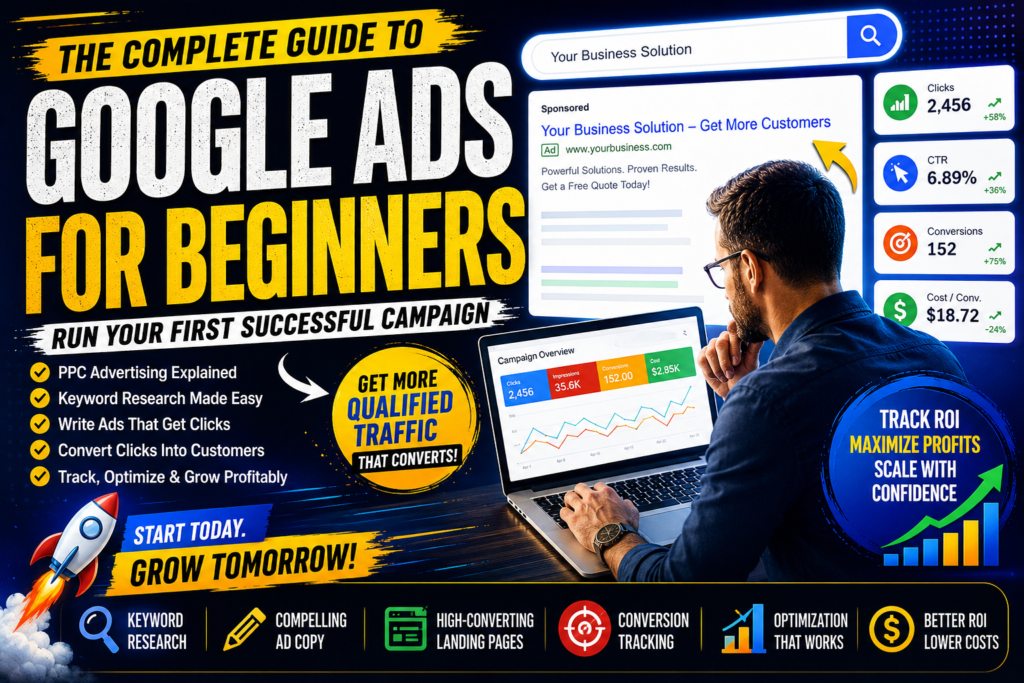
Google Ads for Beginners: How to Run Your First Successful Campaign
Google Ads for Beginners: Complete Guide to PPC Advertising in 2026
Learn Google Ads for beginners with this complete guide to PPC advertising. Discover keywords, search intent, ad copy, budgets, CPC, landing pages, tracking, ROI, and common mistakes.
Your Customers Are Already Searching—Can They Find You?
Imagine someone searching Google for exactly what your business sells.
They type:
“best accounting software for small business”
or
“plumber near me”
or
“digital marketing agency for startups.”
At that exact moment, they’re not casually browsing. They’re actively looking for a solution.
This is where Google Ads can become incredibly powerful.
Unlike many forms of online advertising where you interrupt someone while they’re watching a video, scrolling through social media, or reading an article, Google Search Ads can place your business directly in front of people who are already searching for products or services like yours.
But there’s a catch.
Simply creating a Google Ads account, choosing a few keywords, adding money to your account, and pressing “publish” doesn’t guarantee results. In fact, beginners can burn through their advertising budget surprisingly quickly if they don’t understand keywords, search intent, bidding, landing pages, conversion tracking, and campaign optimization.
The good news?
You don’t need to be a professional PPC specialist to understand the fundamentals.
In this guide to Google Ads for beginners, you’ll learn how Google Ads works, how PPC advertising works, how to choose keywords, how to write effective advertisements, how to set a budget, how Quality Score affects performance, how negative keywords protect your budget, and how to calculate whether your advertising is actually profitable.
By the end, you’ll have a practical framework for building your first Google Ads campaign—and, more importantly, understanding why each part matters.
Table of Contents
- What Is Google Ads?
- How PPC Advertising Works
- Google Ads vs. Organic Search
- Understanding Google Search Ads
- How to Choose the Right Keywords
- Understanding Search Intent
- How to Write Effective Google Ads
- Creating a High-Converting Landing Page
- Setting Your Google Ads Budget
- Understanding Cost Per Click
- What Is Quality Score?
- Using Negative Keywords
- Setting Up Conversion Tracking
- How to Calculate Advertising ROI
- Real-World Google Ads Examples
- Common Google Ads Mistakes Beginners Make
- Actionable Tips for Better Campaign Performance
- A Simple First-Campaign Checklist
- Frequently Asked Questions
- Conclusion
1. What Is Google Ads?
Google Ads is Google’s advertising platform that allows businesses to promote products, services, websites, apps, and other offers across Google’s advertising network.
For beginners, one of the easiest places to start is Google Search Ads.
Search ads can appear when someone searches for keywords related to what you offer.
For example, imagine you operate a web design company.
Someone searches:
“affordable website design for small business”
Your advertisement could appear among the sponsored results.
If the person clicks your ad, you may pay Google for that click.
This is why Google Ads is closely associated with pay-per-click advertising, or PPC.
Google Ads can also be used for other advertising formats, including display campaigns, shopping campaigns, video advertising, app campaigns, and more.
However, beginners often benefit from starting with a focused campaign rather than trying everything at once.
2. How PPC Advertising Works
PPC means pay-per-click.
The basic concept is simple:
- You create an advertisement.
- You select keywords or targeting criteria.
- Someone searches or encounters an eligible advertising placement.
- Your ad may enter Google’s advertising auction.
- If your ad is shown and clicked, you may pay for the click.
- The visitor arrives on your website or landing page.
- Ideally, they complete a valuable action.
That action could be:
- Purchasing a product
- Filling out a form
- Calling your business
- Booking an appointment
- Signing up for a service
- Downloading something
- Requesting a quote
The important thing to understand is that clicks aren’t the final goal.
Conversions are.
Getting 1,000 visitors who don’t buy anything isn’t necessarily better than getting 100 highly targeted visitors who generate 10 customers.
3. Google Ads vs. Organic Search
Google Ads and SEO can both bring visitors from Google, but they work differently.
| Feature | Google Ads | SEO |
| Traffic source | Paid | Organic |
| Immediate visibility | Yes | Usually takes time |
| Cost | Pay for advertising | Investment in content/optimization |
| Control | High | Lower |
| Long-term traffic | Requires continued spending | Can continue after ranking |
| Testing speed | Fast | Slower |
| Best for | Immediate traffic and testing | Long-term visibility |
This doesn’t mean you need to choose one.
A strong digital marketing strategy can use SEO and paid advertising together.
For example, you could use Google Ads to immediately test which keywords generate customers while simultaneously creating SEO content to build long-term organic traffic.
4. Understanding Google Search Ads
For beginners, Search campaigns are often one of the easiest Google Ads campaign types to understand.
Suppose you sell accounting software.
Potential keywords might include:
- accounting software for small business
- small business accounting software
- online accounting software
- accounting software pricing
Someone searches for one of these phrases.
Your ad could potentially appear.
But here’s where targeting becomes important.
You don’t want your advertisement appearing for every vaguely related search.
You want it to appear when the search has a reasonable chance of producing a customer.
That’s why keyword selection and search intent are critical.
5. How to Choose the Right Keywords
Keyword selection can make or break a PPC campaign.
Don’t simply choose keywords because they have high search volume.
Instead, ask:
“Would someone searching this phrase realistically want what I’m selling?”
For example, imagine you’re selling premium accounting software.
Consider these keywords:
High-intent keywords
- buy accounting software
- accounting software pricing
- best accounting software for small business
- accounting software subscription
These searches indicate stronger commercial intent.
Informational keywords
- what is accounting software
- how does accounting software work
- accounting software definition
These people may simply be researching.
That doesn’t mean informational keywords are useless. But they may produce fewer immediate customers.
A useful keyword framework
Divide keywords into three categories:
Informational:
The person wants to learn.
Commercial:
The person is comparing options.
Transactional:
The person is ready to take action.
For many PPC campaigns, transactional and commercially relevant keywords deserve particular attention.
6. Understanding Search Intent
Search intent is the reason behind someone’s search.
This is one of the most important concepts in Google Ads for beginners.
Consider these searches:
“What is a gym membership?”
The user wants information.
“Best gym membership in New York”
The user is comparing options.
“Sign up for gym membership New York”
The user is much closer to taking action.
These searches shouldn’t necessarily receive identical advertising strategies.
The closer the search intent is to your desired conversion, the more valuable the click may potentially be.
Before targeting a keyword, ask:
- What does the searcher actually want?
- Are they researching or buying?
- Does my product answer the query?
- Would they be satisfied after clicking my advertisement?
- Is this keyword commercially relevant?
If the answer is no, reconsider targeting it.
7. How to Write Effective Google Ads
Your advertisement has a very small amount of space to convince someone to click.
Good ad copy should communicate:
What you offer + why you’re valuable + what the visitor should do next.
For example:
Weak:
We Sell Marketing Services
That’s vague.
A stronger version might be:
Digital Marketing for Small Businesses
Grow Traffic, Leads & Online Sales
Get a Free Strategy Consultation
The second example gives the searcher more information.
Elements of strong ad copy
1. Relevance
Match the advertisement closely to the user’s search.
2. Benefit
Explain what the customer gets.
3. Differentiation
Give them a reason to choose you.
4. Call to action
Tell them what to do.
Examples:
- Get a Free Quote
- Shop Now
- Book a Consultation
- Start Today
- Request a Demo
Don’t make exaggerated claims simply to attract clicks.
A click from the wrong person is still money spent.
8. Creating a High-Converting Landing Page
Getting the click is only half the battle.
The visitor now needs to land somewhere useful.
If your advertisement promises:
“Affordable Website Design for Small Businesses”
but the visitor lands on a generic homepage with no obvious information about website design, they may leave.
Your landing page should make sense immediately.
A good landing page should have:
- A clear headline
- A strong value proposition
- Relevant information
- Benefits
- Trust signals
- Testimonials where appropriate
- A visible call-to-action
- Easy navigation
- Fast loading speed
- Mobile-friendly design
The message should flow logically:
Search → Ad → Landing Page → Conversion
If one part doesn’t match the next, performance can suffer.
9. Setting Your Google Ads Budget
One of the biggest concerns for beginners is:
“How much money do I need to start?”
There’s no universal number.
Your budget depends on:
- Industry
- Keyword competition
- Geographic targeting
- Customer value
- Conversion rate
- Cost per click
- Profit margins
Instead of asking:
“What’s the cheapest budget?”
ask:
“How much can I afford to spend while collecting enough data to make informed decisions?”
For example, suppose your average CPC is $2.
A $20 daily budget could theoretically generate around 10 clicks per day if the campaign consistently achieved that CPC.
But actual results can vary.
A campaign with expensive keywords may generate fewer clicks.
The goal isn’t simply to buy the largest number of clicks.
It’s to generate profitable conversions.
10. Understanding Cost Per Click
CPC stands for cost per click.
The basic calculation is:
CPC = Advertising Spend ÷ Number of Clicks
For example:
You spend $100.
You receive 50 clicks.
Your average CPC is:
$100 ÷ 50 = $2
But CPC by itself doesn’t tell you whether the campaign is successful.
Imagine two campaigns:
Campaign A
$2 CPC
100 clicks
0 customers
Campaign B
$4 CPC
50 clicks
10 customers
Campaign B has a higher CPC but could be dramatically more profitable.
That’s why you should always connect CPC to conversions and revenue.
11. What Is Quality Score?
Quality Score is Google’s diagnostic measurement that evaluates the relevance and quality of your ads and landing pages for particular keywords.
Factors associated with Quality Score include:
- Expected click-through rate
- Ad relevance
- Landing page experience
Generally, improving relevance can help create a better advertising experience.
Think about the journey:
Keyword → Advertisement → Landing Page
If all three closely match, the experience makes sense.
For example:
Keyword:
“small business tax software”
Ad:
Tax Software for Small Businesses
Landing page:
Small Business Tax Software — Start Today
That’s a much more coherent journey than sending the same visitor to a completely unrelated homepage.
12. Using Negative Keywords
Negative keywords are one of the most useful tools for controlling wasted advertising spend.
They tell Google that you don’t want your advertisements triggered by certain searches.
Imagine you sell premium business software.
You might not want to pay for searches containing:
- free
- download
- tutorial
- jobs
- careers
depending on your business.
For example, someone searching:
“free accounting software download”
may not be interested in paying for your premium software.
If your campaign keeps attracting these searches, negative keywords can help reduce irrelevant traffic.
Beginner tip
Regularly review your search terms and ask:
“Would I happily pay for this person to visit my website?”
If the answer is no, consider whether you need to adjust your keyword targeting or add a negative keyword.
13. Setting Up Conversion Tracking
This is one of the most important steps beginners often overlook.
Without conversion tracking, you may know how many clicks you received but not whether those clicks produced business results.
You could track:
- Purchases
- Form submissions
- Phone calls
- Sign-ups
- App downloads
- Bookings
- Quote requests
Suppose you spend $500.
You receive:
1,000 clicks
50 leads
10 customers
Now you can start evaluating the campaign economically.
Without conversion tracking, you might simply see:
1,000 clicks
and assume the campaign is successful.
But clicks aren’t revenue.
Conversions provide the missing piece.
14. How to Calculate Advertising ROI
ROI stands for return on investment.
A simple formula is:
ROI = (Profit from Advertising − Advertising Cost) ÷ Advertising Cost × 100
For example:
You spend $1,000 on Google Ads.
The campaign generates $3,000 in profit attributable to the advertising.
Your ROI would be:
($3,000 − $1,000) ÷ $1,000 × 100 = 200%
That’s a 200% ROI.
However, be careful when calculating this.
Revenue isn’t the same as profit.
Suppose advertising generates $5,000 in sales but your product costs $3,000 to fulfill.
Your true profit is much lower.
A useful PPC analysis should consider:
Revenue − product/service costs − advertising costs − other relevant expenses.
15. Real-World Google Ads Examples
Example 1: Local Plumber
Imagine a plumbing company targeting searches such as:
“emergency plumber near me”
Someone searching this is likely to have immediate intent.
The advertisement could emphasize:
- 24/7 availability
- Local service
- Fast response
- Phone calls
- Emergency appointments
The landing page should make contacting the plumber extremely easy.
Example 2: Online Course
An online course company could target searches like:
“digital marketing course online”
Instead of sending users to a generic homepage, the advertisement could take them directly to the relevant course page.
The landing page could include:
- Course benefits
- Curriculum
- Instructor information
- Reviews
- Pricing
- Enrollment button
Example 3: E-commerce Business
An online clothing store might use paid advertising to promote products people are actively searching for.
Instead of simply advertising:
“Shop Our Store”
the campaign could focus on specific product categories.
For example:
“Women’s Linen Dresses — Shop New Arrivals”
The more closely the advertisement matches the user’s search and destination page, the more coherent the customer journey becomes.
16. Common Google Ads Mistakes Beginners Make
Mistake 1: Targeting Too Many Keywords
Starting with hundreds of keywords can make your campaign difficult to manage.
Start focused.
Mistake 2: Ignoring Search Intent
A keyword may have huge search volume but terrible commercial relevance.
Mistake 3: Sending Everyone to the Homepage
Create landing pages that match your advertisements.
Mistake 4: Not Using Negative Keywords
Irrelevant searches can consume your budget.
Mistake 5: Optimizing Only for Clicks
A campaign can generate clicks without generating customers.
Mistake 6: Not Tracking Conversions
Without conversion data, optimization becomes guesswork.
Mistake 7: Changing Everything Too Quickly
Don’t constantly change campaigns without allowing enough useful data to accumulate.
Mistake 8: Writing Generic Ads
Your advertisement needs to explain why someone should click.
Mistake 9: Ignoring Mobile Users
A large percentage of online searches occur on mobile devices.
Your landing pages should work well on smaller screens.
Mistake 10: Focusing Only on Cheap Clicks
A cheap click isn’t necessarily a valuable click.
17. Actionable Tips for Better Google Ads Performance
Tip 1: Start Narrow
Focus on a specific product, service, location, or customer need.
Tip 2: Group Similar Keywords
Organize closely related keywords so your advertisements remain relevant.
Tip 3: Match Search Intent
Don’t advertise the same way to someone researching and someone ready to buy.
Tip 4: Improve Your Landing Pages
Your landing page should deliver exactly what the advertisement promises.
Tip 5: Monitor Search Terms
Look at what people actually searched before clicking your advertisements.
Tip 6: Add Negative Keywords
Remove recurring irrelevant searches.
Tip 7: Track Real Business Results
Measure leads, sales, bookings, or whatever your actual business goal is.
Tip 8: Test Your Messaging
Experiment with different headlines, benefits, offers, and calls to action.
Tip 9: Calculate Profitability
Don’t stop at impressions and clicks.
Ask:
How much money did this campaign actually make?
Tip 10: Optimize Based on Data
Use campaign performance to make decisions rather than changing settings randomly.
18. A Simple First Google Ads Campaign Checklist
Before launching your first campaign, work through this list:
Campaign strategy
☐ Define your advertising goal
☐ Identify your target customer
☐ Choose your geographic targeting
☐ Decide what product/service you’re promoting
Keywords
☐ Research relevant keywords
☐ Analyze search intent
☐ Prioritize commercially valuable searches
☐ Identify negative keywords
Advertisement
☐ Write relevant headlines
☐ Highlight benefits
☐ Include a clear CTA
☐ Make the message match the keyword
Landing page
☐ Create a relevant landing page
☐ Add a clear headline
☐ Explain the offer
☐ Add trust signals
☐ Make the CTA obvious
☐ Optimize for mobile
Tracking
☐ Install conversion tracking
☐ Define your conversion actions
☐ Connect conversions to campaigns
☐ Monitor cost per conversion
Optimization
☐ Review search terms
☐ Add negative keywords
☐ Monitor CPC
☐ Monitor conversion rate
☐ Calculate ROI
☐ Improve underperforming areas
19. Frequently Asked Questions About Google Ads for Beginners
Is Google Ads suitable for beginners?
Yes. Google Ads can be used by beginners, but understanding the fundamentals is important before spending significant money.
Start with a simple campaign and learn from the data.
How much does Google Ads cost?
There is no single fixed price.
You control your advertising budget, while actual costs can vary depending on competition, keywords, location, industry, bidding, and other factors.
Is Google Ads PPC?
Yes. Google Search Ads commonly operate using a PPC model, meaning advertisers can pay when users click their advertisements.
What is a good CPC?
There isn’t one universal “good” CPC.
A $5 CPC could be excellent for a high-value customer and terrible for a low-margin product.
The more important question is:
How much does it cost to acquire a customer, and how much profit does that customer generate?
How many keywords should a beginner use?
Quality matters more than quantity.
Rather than targeting hundreds of loosely related keywords, begin with a focused group that closely matches your offer.
What are negative keywords?
Negative keywords help prevent your ads from appearing for searches that aren’t relevant to your business.
What is Quality Score?
Quality Score is Google’s diagnostic measurement related to the expected relevance and experience associated with your ads and landing pages for keywords.
How long does it take for Google Ads to work?
Some campaigns can generate clicks and conversions quickly, but meaningful optimization generally requires collecting enough data to understand what is working.
Don’t judge an entire campaign from a handful of clicks.
Can small businesses use Google Ads?
Absolutely.
PPC for small business can be effective when campaigns are tightly targeted and conversions are tracked.
A small business doesn’t necessarily need to compete for every keyword.
It can focus on highly relevant searches, locations, products, or services.
Is Google Ads better than SEO?
Neither is automatically better.
Google Ads can provide paid visibility relatively quickly, while SEO can build longer-term organic visibility.
Many businesses benefit from using both.
20. Conclusion: Don’t Just Buy Clicks—Build a System
Google Ads can look intimidating when you first open the advertising platform.
There are campaigns, ad groups, keywords, bidding strategies, budgets, conversion actions, Quality Scores, search terms, landing pages, and enough settings to make a beginner’s head spin.
But the underlying principle is much simpler.
Find the right person.
Show them the right message.
Send them to the right page.
Make it easy for them to take action.
Measure the result.
Then improve.
That’s the foundation of successful PPC advertising.
The biggest mistake beginners make isn’t necessarily having a small advertising budget. It’s spending money without understanding what they’re measuring.
A campaign receiving thousands of impressions isn’t automatically successful.
A campaign receiving hundreds of clicks isn’t automatically successful.
Even a campaign producing sales isn’t necessarily successful if those sales cost more to acquire than they’re worth.
The real objective is profitable customer acquisition.
Start with a clearly defined goal. Choose keywords based on relevance and search intent. Write advertisements that directly address what people are searching for. Build landing pages that deliver on your promises.
Set a budget you can comfortably test with. Track conversions from the beginning. Use negative keywords to reduce irrelevant traffic. Monitor CPC and conversion rates, and calculate your actual advertising ROI.
Most importantly, treat your first campaign as a learning process.
You won’t necessarily get everything perfect on day one—and that’s okay.
The businesses that succeed with Google Ads for beginners aren’t necessarily the ones that know every feature before launching.
They’re the ones that launch carefully, measure what happens, learn from the data, and continuously improve.
Google Ads isn’t simply about paying Google to send people to your website.
It’s about building a measurable path from search → click → customer → revenue.
Once you understand that system, paid advertising becomes far less mysterious—and much more powerful.
