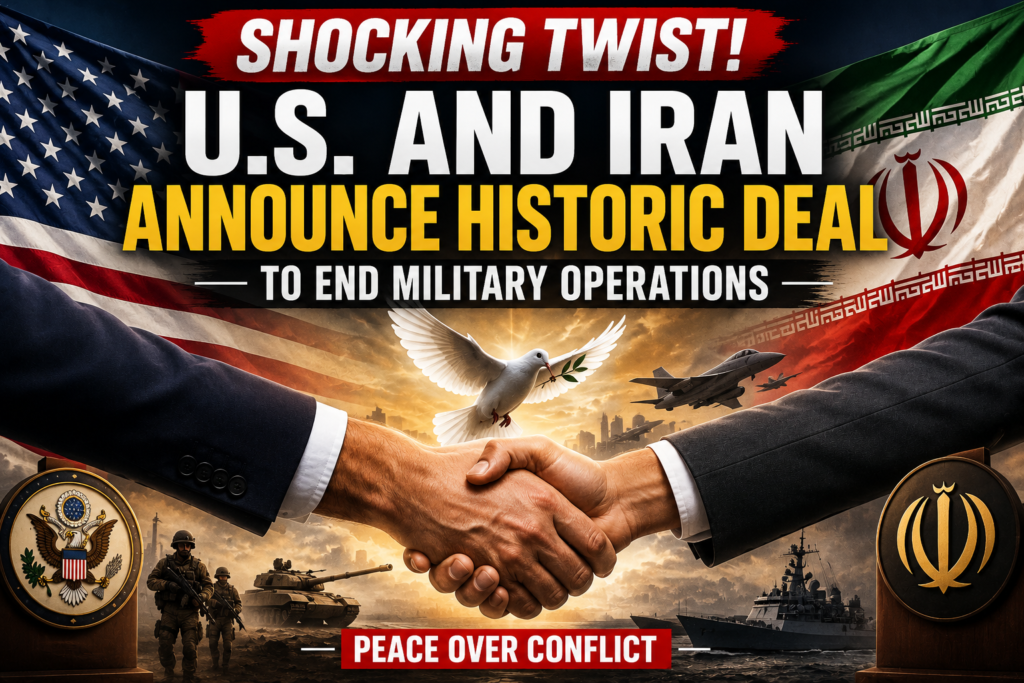
In a stunning development that few experts saw coming, the United States and Iran have announced a breakthrough agreement to end military operations, potentially bringing an end to months of conflict that pushed the Middle East to the brink and rattled the global economy.
The surprise announcement, revealed by U.S. President Donald Trump and confirmed by Pakistani officials involved in mediation efforts, has sent shockwaves through international politics and financial markets. The deal reportedly calls for an immediate halt to military operations and could mark one of the most dramatic diplomatic turnarounds in recent history. (Reuters)
“The Deal Is Complete”
President Trump declared on social media that a deal with Iran had been finalized, describing it as a major achievement and signaling that the two longtime adversaries were ready to move beyond active conflict.
The agreement is expected to be formally signed later this week in Switzerland, where diplomats from both sides are scheduled to meet. While many details remain confidential, early reports suggest the framework includes a permanent ceasefire and the reopening of the strategically vital Strait of Hormuz, one of the world’s most important oil shipping routes. (WUSF)
For decades, tensions between Washington and Tehran have fueled instability throughout the region. Military confrontations, sanctions, proxy conflicts, and nuclear disputes have repeatedly pushed relations to the breaking point. Now, the possibility of a lasting peace deal has left observers wondering whether history is finally being rewritten.
Oil Markets React Instantly
Perhaps nowhere was the impact felt more quickly than in global energy markets.
The mere announcement of the agreement reportedly sent oil prices tumbling as traders anticipated the reopening of shipping routes and a reduction in geopolitical risk. The Strait of Hormuz carries a significant portion of the world’s oil exports, and any disruption there can trigger massive price spikes across the globe. (Reuters)
If the agreement holds, consumers could eventually see lower fuel prices, reduced transportation costs, and greater market stability.
But analysts warn that optimism may be running ahead of reality.
The Catch Nobody Is Talking About
Despite the celebratory headlines, major issues remain unresolved.
The most significant challenge is Iran’s nuclear program. Reports indicate that the current agreement serves as a framework rather than a final settlement. A 60-day negotiation period is expected to follow, during which both sides will attempt to address sanctions, nuclear restrictions, uranium stockpiles, and broader security concerns. (Reuters)
In other words, the fighting may be stopping, but the hardest conversations are only beginning.
Some experts fear that if negotiations break down during this critical period, tensions could quickly return.
Global Leaders Welcome the Deal
World leaders and international organizations have largely reacted positively to the announcement.
The United Nations welcomed the agreement and urged all parties to implement the terms in good faith. Several European nations have also expressed support, viewing the breakthrough as an opportunity to stabilize the region and reduce the risk of a wider conflict. (Reuters)
Pakistan, which played a key role in facilitating negotiations, described the agreement as a major diplomatic achievement and called on all sides to maintain momentum toward a comprehensive peace settlement. (Reuters)
Could This Change the Middle East Forever?
That is now the question dominating discussions in diplomatic circles.
Supporters argue that the agreement could reshape the geopolitical landscape, reduce regional tensions, and open the door to broader cooperation. Critics, however, point out that previous ceasefires and diplomatic breakthroughs in the region have often collapsed under pressure.
There is also uncertainty regarding how various regional actors will respond and whether all parties affected by the conflict will fully embrace the terms of the agreement. (The Guardian)
Still, for the first time in months, there is a sense of cautious optimism.
What Happens Next?
All eyes are now on Switzerland, where officials are expected to formally sign the agreement later this week.
If successful, the signing could mark the beginning of a new chapter in one of the world’s most volatile geopolitical rivalries. If negotiations fail, however, the current optimism could prove short-lived.
For now, markets are cheering, diplomats are celebrating, and millions around the world are watching closely.
After months of warfare, uncertainty, and fears of a wider regional conflict, the unthinkable has happened:
The United States and Iran say they are ready to stop fighting.
The world is waiting to see whether this historic promise becomes lasting peace—or just another fragile ceasefire in a region that has seen too many of them.
