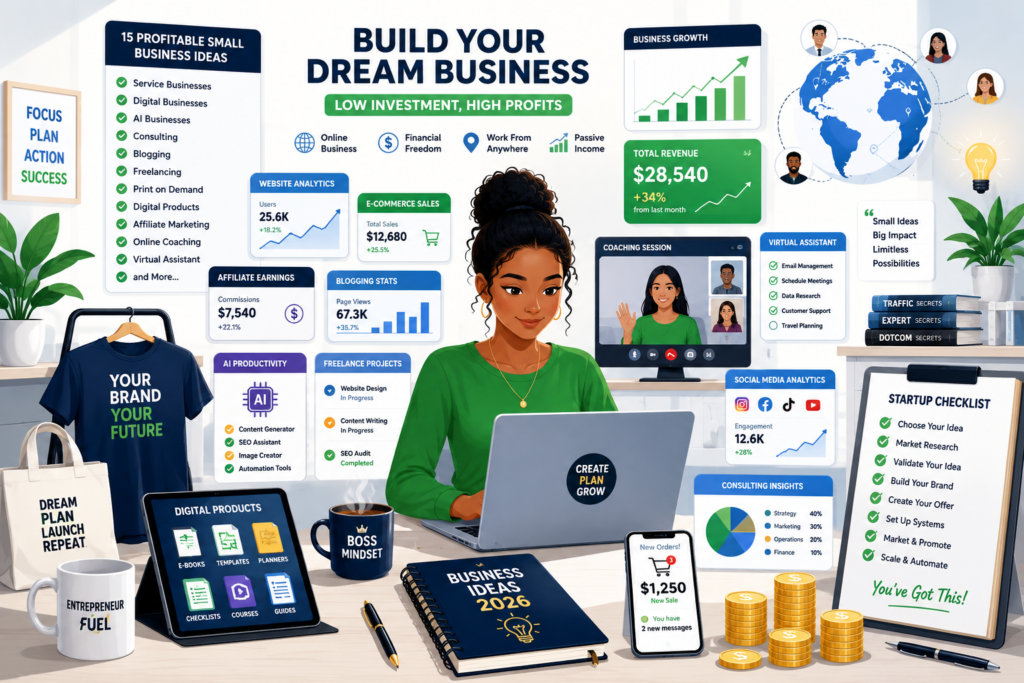
15 Profitable Small Business Ideas You Can Start With Low Investment (2026 Guide)
Looking for profitable small business ideas? Discover 15 low-cost business ideas you can start in 2026, including online businesses, AI businesses, freelancing, blogging, consulting, and more. Learn startup costs, income potential, pros, and cons.
15 Profitable Small Business Ideas You Can Start With Low Investment
Introduction
Starting a business no longer requires thousands of dollars, an expensive office, or a team of employees. In 2026, anyone with a laptop, internet connection, and determination can build a profitable business from home.
The rise of artificial intelligence, digital marketing, remote work, and e-commerce has created opportunities that simply didn’t exist a few years ago. Whether you’re looking to replace your full-time income, earn extra money on weekends, or build long-term financial freedom, there has never been a better time to become your own boss.
The biggest mistake many beginners make is believing they need the “perfect” business idea before getting started. The truth is that success usually comes from choosing a business that matches your skills, solving real problems, and staying consistent over time.
In this guide, you’ll discover 15 profitable small business ideas with low startup costs, realistic income expectations, advantages, disadvantages, and practical advice to help you choose the right one.
Whether you’re a student, stay-at-home parent, office worker, or aspiring entrepreneur, one of these businesses could become your next source of income.
Table of Contents
- Why Start a Small Business in 2026?
- How to Choose the Right Business
- Comparison Table
- 15 Profitable Small Business Ideas
- Tips for Growing Your Business Faster
- Common Mistakes to Avoid
- Frequently Asked Questions
- Conclusion
Why Start a Small Business in 2026?
Several trends make 2026 an excellent year for entrepreneurs:
- AI tools reduce startup costs.
- Online marketing is more accessible than ever.
- Remote work has become normal.
- Customers are increasingly buying online.
- Digital products create passive income.
- Global audiences are easier to reach through social media.
- Low-cost software makes running a business simpler than ever.
Instead of waiting for the “perfect time,” many successful entrepreneurs start small and improve as they go.
How to Choose the Right Business
Before investing your time and money, ask yourself:
- What skills do I already have?
- What problems can I solve?
- Do I enjoy working with people or independently?
- Do I prefer online or offline work?
- How much money can I invest?
- How much time can I dedicate each week?
Choosing a business that aligns with your strengths increases your chances of long-term success.
Comparison Table
| Business | Startup Cost | Income Potential | Difficulty | Scalability |
| Blogging | Low | High | Medium | Excellent |
| Freelancing | Very Low | High | Easy | Moderate |
| Virtual Assistant | Low | Medium-High | Easy | High |
| Affiliate Marketing | Low | High | Medium | Excellent |
| Print on Demand | Low | High | Medium | Excellent |
| Digital Products | Low | Very High | Medium | Excellent |
| Online Coaching | Low | Very High | Medium | High |
| AI Services | Low | High | Medium | Excellent |
| Consulting | Very Low | Very High | Medium | Moderate |
| Social Media Management | Low | High | Medium | High |
| SEO Services | Low | High | Medium | High |
| Graphic Design | Low | High | Medium | High |
| Online Store | Medium | High | Medium | Excellent |
| YouTube Automation | Low | High | Hard | Excellent |
| Online Course Business | Low | Very High | Medium | Excellent |
1. Blogging
Blogging remains one of the best long-term business models.
You create valuable content that attracts visitors from search engines and earn money through:
- Display ads
- Affiliate marketing
- Sponsored posts
- Digital products
- Courses
Startup Cost
$50–$200
Income Potential
$500–$20,000+ per month
Pros
- Passive income
- High scalability
- Multiple income streams
- Can work from anywhere
Cons
- Takes time to grow
- Requires consistent publishing
- SEO learning curve
2. Freelancing
Offer your existing skills online.
Popular freelance services include:
- Writing
- Graphic design
- Programming
- Video editing
- Translation
- Marketing
Startup Cost
Under $100
Income Potential
$500–$10,000+ monthly
Pros
- Fastest way to earn
- Flexible schedule
- Work from home
Cons
- Trading time for money
- Finding clients initially can be challenging
3. Affiliate Marketing
Promote products and earn commissions without creating your own products.
Examples include:
- Software
- Hosting
- Finance tools
- Online courses
- Amazon products
Startup Cost
$50–$300
Income Potential
$500–$50,000+ monthly
Pros
- No inventory
- Passive income
- Works alongside blogging or YouTube
Cons
- Requires audience
- Income can fluctuate
4. Selling Digital Products
Digital products include:
- Templates
- eBooks
- Printables
- Planners
- Checklists
- Notion templates
Startup Cost
Under $100
Income Potential
$500–$30,000+ monthly
Pros
- No shipping
- High profit margins
- Passive income
Cons
- Competition
- Requires quality products
5. Print on Demand
Design products like:
- T-shirts
- Hoodies
- Mugs
- Posters
- Phone cases
The supplier prints and ships after every order.
Startup Cost
$0–$200
Income Potential
$300–$15,000+ monthly
Pros
- No inventory
- Automated fulfillment
- Worldwide customers
Cons
- Lower profit margins
- Design quality matters
6. AI Services Business
Businesses increasingly need AI assistance.
Offer services like:
- AI content creation
- AI automation
- Chatbot setup
- Prompt engineering
- AI consulting
Startup Cost
Under $200
Income Potential
$1,000–$20,000 monthly
Pros
- High demand
- Premium pricing
- Growing industry
Cons
- Requires continuous learning
7. Online Coaching
Help people achieve goals in areas such as:
- Fitness
- Career
- Business
- Finance
- Language learning
- Productivity
Startup Cost
$100–$500
Income Potential
$2,000–$50,000 monthly
Pros
- High-ticket services
- Flexible schedule
Cons
- Requires expertise
- Building trust takes time
8. Consulting
Businesses pay consultants to solve problems.
Popular consulting niches:
- Marketing
- HR
- Business strategy
- Finance
- Operations
- IT
Startup Cost
Under $100
Income Potential
$2,000–$30,000 monthly
Pros
- Premium pricing
- Flexible work
Cons
- Expertise required
- Client acquisition
9. Virtual Assistant Business
Entrepreneurs need help managing:
- Emails
- Scheduling
- Customer support
- Research
- Data entry
- Social media
Startup Cost
Under $100
Income Potential
$800–$6,000 monthly
Pros
- Beginner-friendly
- Remote work
Cons
- Time-based income
10. Social Media Management
Many businesses lack time to manage their social accounts.
Services include:
- Content scheduling
- Engagement
- Analytics
- Content creation
- Advertising
Startup Cost
$100–$300
Income Potential
$1,000–$10,000 monthly
Pros
- Recurring clients
- Growing demand
Cons
- Platform updates
- Managing multiple accounts
11. SEO Services
Help businesses rank on Google.
Offer:
- Keyword research
- Technical SEO
- On-page SEO
- Link building
- Content optimization
Startup Cost
$100–$500
Income Potential
$2,000–$20,000 monthly
Pros
- High-value service
- Recurring income
Cons
- Continuous algorithm changes
12. Graphic Design Business
Create:
- Logos
- Social media graphics
- Brand identities
- Presentations
- Marketing materials
Startup Cost
$100–$500
Income Potential
$1,000–$15,000 monthly
Pros
- Creative work
- Global clients
Cons
- Competitive market
13. Online Store
Sell products through your own website.
Examples:
- Beauty products
- Home décor
- Pet accessories
- Fashion
- Electronics accessories
Startup Cost
$300–$2,000
Income Potential
Unlimited
Pros
- Brand ownership
- Scalable
Cons
- Customer support
- Inventory (unless dropshipping)
14. YouTube Automation
Build channels where creators outsource scripting, editing, voiceovers, and thumbnails.
Revenue sources include:
- Ads
- Sponsorships
- Affiliate marketing
Startup Cost
$200–$1,000
Income Potential
$500–$50,000 monthly
Pros
- Passive income potential
- Huge audience
Cons
- Slow growth initially
- Higher production effort
15. Online Course Business
Package your knowledge into structured lessons.
Topics include:
- Coding
- Photography
- Investing
- Business
- Design
- Languages
Startup Cost
$100–$500
Income Potential
$2,000–$100,000+ monthly
Pros
- Passive income
- High profit margins
- Global customers
Cons
- Time to create
- Marketing required
Real-World Examples
Example 1: Sarah the Freelance Writer
Sarah started offering blog writing services while working a full-time job. Within one year, she built a portfolio of recurring clients and eventually transitioned into full-time freelancing, earning significantly more than her previous salary.
Example 2: Michael the Blogger
Michael launched a personal finance blog focused on beginner-friendly advice. By publishing SEO-optimized articles consistently and monetizing with display ads and affiliate links, his website grew into a reliable source of recurring monthly income.
Example 3: Lisa the Digital Product Creator
Lisa created printable budgeting templates and planners. After listing them on online marketplaces and promoting them through social media, she began earning sales around the clock without shipping physical products.
Example 4: James the AI Consultant
James learned how businesses could automate repetitive tasks using AI tools. He started by helping small companies implement chatbots and workflow automation, eventually turning his expertise into a thriving consulting business with premium clients.
Actionable Tips for Success
Start Before You Feel Ready
Many entrepreneurs wait for the perfect idea or perfect timing. Launching a simple version of your business and improving it over time is often more effective than waiting.
Focus on Solving One Problem
Businesses that solve a specific problem for a defined audience are easier to market than those trying to help everyone.
Build an Online Presence
Create a professional website, optimize it for search engines, and maintain active social media profiles to build credibility and attract customers.
Use AI to Increase Productivity
Leverage AI tools to help with research, content creation, customer support, scheduling, and administrative tasks. This can save time and reduce operating costs.
Develop Multiple Income Streams
For example, a blogger can earn from display ads, affiliate marketing, digital products, sponsorships, and online courses. Diversifying income reduces risk.
Keep Learning
Industries evolve quickly. Invest time in learning new skills, following market trends, and improving your expertise to stay competitive.
Reinvest Your Profits
Instead of spending your early earnings, use them to improve your website, purchase better tools, invest in marketing, or outsource repetitive tasks.
Common Mistakes to Avoid
- Trying to start several businesses at once instead of focusing on one.
- Ignoring customer feedback and failing to improve your offerings.
- Expecting overnight success instead of committing to consistent effort.
- Neglecting marketing and relying solely on word of mouth.
- Underpricing your products or services.
- Failing to manage business finances and separate them from personal expenses.
- Giving up too early before your business has had time to gain traction.
Frequently Asked Questions
Which small business is most profitable?
Digital businesses such as blogging, affiliate marketing, online courses, AI services, and consulting often have the highest profit margins because they require little inventory and can scale globally.
Which business is best for beginners?
Freelancing, virtual assistant services, print on demand, and blogging are among the best business ideas for beginners due to their relatively low startup costs and accessible learning curve.
How much money do I need to start?
Many of the businesses in this guide can be started with less than $100. Others may require a few hundred dollars for software, marketing, or equipment, but none require a large upfront investment.
Can I start while working a full-time job?
Yes. Many entrepreneurs begin their businesses during evenings or weekends until they build enough income to transition full time.
Which business has the highest passive income potential?
Blogging, affiliate marketing, digital products, print on demand, and online courses can all generate passive income once the initial work has been completed and the business is properly marketed.
What are the fastest businesses to make money?
Freelancing, consulting, virtual assistant services, and social media management can often generate income within weeks because you are selling skills directly to clients.
How long does it take to build a successful business?
The timeline varies depending on the business model, niche, and consistency. Service-based businesses can often produce income quickly, while content-based businesses like blogging or YouTube typically take several months before generating significant revenue.
Conclusion
Starting a small business in 2026 doesn’t require a huge budget—it requires the willingness to take action, solve real problems, and remain consistent. Whether you choose freelancing for quick income, blogging for long-term passive earnings, AI services for a fast-growing market, or digital products for scalability, the key is to start with one idea and execute it well.
Every successful entrepreneur began with a first step. Focus on building value for your customers, continuously improve your skills, and reinvest in your business as it grows. Over time, your small venture can evolve into a sustainable source of income and even full financial independence.
Remember, there is no single “best” business idea. The best choice is the one that aligns with your skills, interests, available resources, and long-term goals. Pick one idea from this guide, create a simple plan, take consistent action, and keep learning. Your future business success starts with the decision to begin today.
How to Start an Online Business From Scratch in 2026: The Complete Step-by-Step Beginner’s Guide
