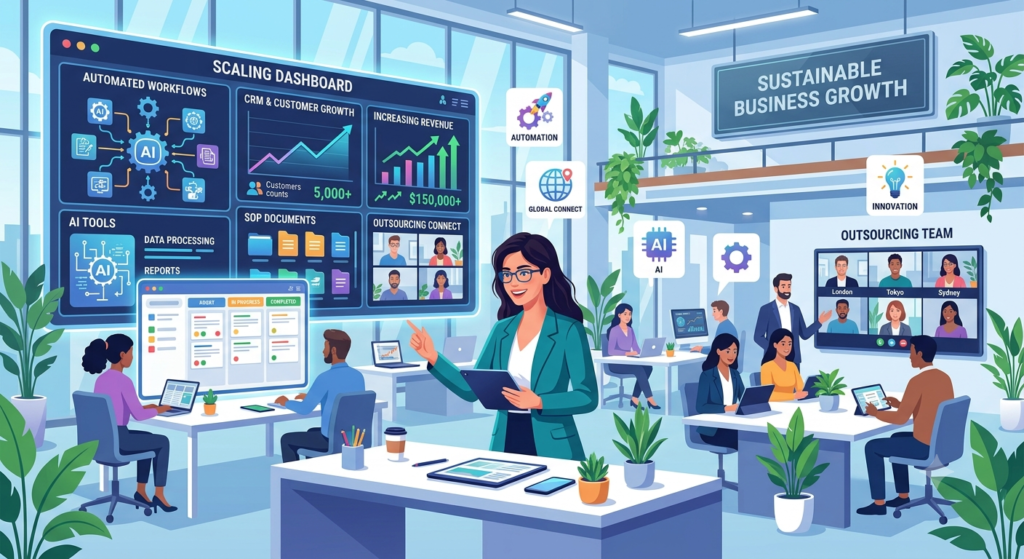
How to Scale a Business Without Burning Out: The Complete Guide to Sustainable Business Growth in 2026
Learn how to scale a business without burning out. Discover business growth strategies, hiring tips, delegation, automation, SOPs, outsourcing, KPIs, and common scaling mistakes.
How to Scale a Business Without Burning Out
The Complete Guide to Sustainable Business Growth
Every entrepreneur dreams about building a successful business. More customers, higher profits, bigger teams, and stronger brand recognition all sound exciting. But many business owners discover that as their company grows, so does the workload.
Instead of enjoying the rewards of success, they find themselves working longer hours, making every decision, answering every email, solving every problem, and constantly putting out fires. Eventually, the business owns them instead of the other way around.
This happens because many entrepreneurs focus only on business growth without understanding how to scale a business properly.
Growth often means adding more resources to generate more revenue. Scaling, on the other hand, means increasing revenue much faster than expenses by improving efficiency, systems, automation, and delegation.
The businesses that thrive for years aren’t necessarily those that work the hardest—they’re the ones that build processes that allow the company to operate smoothly without depending on the owner for every decision.
Whether you run an online store, consulting agency, restaurant, blog, software company, or local service business, this guide will show you exactly how to scale a small business while protecting your time, health, and profits.
Table of Contents
- What Does It Mean to Scale a Business?
- Growth vs Scaling
- Signs You’re Ready to Scale
- Build Systems Before You Grow
- Hiring Your First Employee
- The Power of Delegation
- Business Automation
- Creating Standard Operating Procedures (SOPs)
- Outsourcing Without Losing Quality
- Customer Retention Strategies
- Increasing Profit Margins
- KPIs Every Business Should Track
- Common Scaling Mistakes
- Action Plan
- Frequently Asked Questions
- Conclusion.
What Does It Mean to Scale a Business?
How to scale a business means increasing revenue while keeping costs under control.
Instead of simply working more hours, scaling allows your business to handle more customers using better systems, technology, and people.
Imagine this:
Business A doubles sales.
To do this they:
- Double employees
- Double office space
- Double expenses
Profit barely changes.
Business B doubles sales.
They:
- Automate repetitive work
- Improve processes
- Delegate tasks
- Increase productivity
Revenue doubles while costs rise only slightly.
Business B is scaling.
Growth vs Scaling
Many people confuse business growth with scaling.
| Business Growth | Business Scaling |
| Revenue increases | Revenue increases significantly |
| Costs increase equally | Costs grow much slower |
| More employees needed | Better efficiency first |
| Owner works more | Owner works smarter |
| Limited by time | Built for expansion |
| Manual processes | Automated systems |
Example
A bakery hires five new staff members because customer demand increases.
Revenue grows 30%.
Payroll also increases 30%.
That’s growth.
Another bakery introduces online ordering, automated inventory management, and delivery partnerships.
Revenue grows 60%.
Expenses increase only 15%.
That’s scaling.
Signs You’re Ready to Scale
Scaling too early can destroy a business.
Look for these indicators first:
Consistent Revenue
Monthly income is predictable instead of random.
Strong Demand
Customers regularly purchase your products or services.
Repeat Customers
People come back without expensive advertising every time.
Positive Cash Flow
Your business generates enough cash to invest in growth.
Reliable Processes
Daily operations are already organized.
Stable Product
Your offer consistently satisfies customers.
Build Business Systems Before You Grow
One of the biggest secrets behind every successful company is systems.
Systems reduce mistakes.
Systems save time.
Systems create consistency.
Without systems, growth creates chaos.
Examples include:
- Customer onboarding
- Order fulfillment
- Inventory management
- Accounting
- Marketing
- Sales
- Customer support
Instead of asking yourself:
“How do I do this?”
Ask:
“How can this happen automatically every single time?”
Hiring Your First Employee
Many entrepreneurs wait too long before hiring.
Others hire too quickly.
The best time is when repetitive tasks prevent you from focusing on activities that actually grow the business.
Start With Tasks—Not Titles
Don’t think:
“I need a manager.”
Instead think:
“I need someone to answer customer emails.”
“I need someone to package products.”
“I need someone to schedule appointments.”
Hire based on business needs.
Your First Hire Could Be
- Virtual assistant
- Customer service representative
- Sales assistant
- Marketing assistant
- Bookkeeper
- Operations assistant
Tips for Hiring Successfully
Hire for attitude
Skills can be taught.
Character cannot.
Document responsibilities
Employees should know exactly what success looks like.
Start small
Begin part-time or freelance if necessary.
Train properly
Investing in training reduces future problems.
Real-World Example
A solo eCommerce owner spends five hours daily answering customer questions.
After hiring a virtual assistant:
- Customer response time improves
- Sales increase
- The owner gains 25 hours every week to focus on marketing.
The Power of Delegation
Many entrepreneurs secretly believe:
“No one can do it better than me.”
This mindset limits business growth.
Delegation doesn’t mean giving away responsibility.
It means assigning responsibility while maintaining accountability.
Tasks You Should Delegate
Administrative work
Scheduling
Bookkeeping
Customer support
Graphic design
Social media posting
Data entry
Inventory updates
Email management
Basic marketing
Tasks You Should Keep
Business strategy
Major financial decisions
Company vision
Culture
Key partnerships
High-level hiring
Actionable Delegation Tips
- Give clear instructions.
- Set deadlines.
- Define expected outcomes.
- Avoid micromanaging.
- Review results regularly.
- Provide feedback.
Business Automation
Automation is one of the fastest ways to grow your company without increasing workload.
Automation handles repetitive work while your team focuses on valuable tasks.
Areas You Can Automate
Email Marketing
Welcome emails
Follow-up sequences
Abandoned cart reminders
Newsletters
Accounting
Invoice generation
Expense tracking
Payroll
Tax calculations
Customer Support
Chatbots
FAQs
Ticket routing
Automatic replies
Social Media
Scheduling posts
Analytics
Content planning
Cross-platform publishing
Sales
CRM updates
Lead nurturing
Appointment booking
Quote generation
Benefits of Automation
- Faster service
- Lower labor costs
- Fewer mistakes
- Better customer experience
- More consistent operations
- Higher productivity
Create Standard Operating Procedures (SOPs)
One reason businesses struggle to scale is because knowledge exists only inside the owner’s head.
That’s risky.
SOPs solve this problem.
An SOP is a step-by-step guide explaining exactly how a task should be completed.
Examples of SOPs
Employee onboarding
Customer complaint handling
Processing refunds
Packing orders
Creating invoices
Publishing blog posts
Running Facebook ads
Sales calls
Inventory checks
Payroll processing
Simple SOP Structure
Purpose
Required tools
Step-by-step instructions
Screenshots
Common mistakes
Expected result
Review schedule
Benefits
New employees learn faster.
Quality stays consistent.
Training costs decrease.
Owners spend less time answering questions.
Outsourcing Without Losing Quality
You don’t have to hire full-time employees for everything.
Many businesses scale faster through outsourcing.
Commonly Outsourced Tasks
Graphic design
Website development
Accounting
SEO
Content writing
Video editing
Customer service
Legal services
IT support
Advertising
Tips
Choose specialists.
Check reviews.
Request samples.
Start with small projects.
Communicate expectations clearly.
Measure performance.
Example
Instead of spending 20 hours designing marketing materials every month, a business owner hires a freelance designer.
The owner spends those 20 hours meeting clients and generating more revenue.
Customer Retention Is Cheaper Than Customer Acquisition
Many entrepreneurs focus only on attracting new customers.
But keeping existing customers is often far more profitable.
Returning customers:
- Buy more often
- Spend more money
- Trust your business
- Recommend friends
- Cost less to serve
Customer Retention Strategies
Provide excellent customer service.
Respond quickly.
Reward loyal customers.
Collect feedback.
Offer personalized recommendations.
Send follow-up emails.
Create loyalty programs.
Solve problems immediately.
Real-World Example
A coffee shop launches a digital loyalty card.
Customers receive a free drink after ten purchases.
Repeat visits increase significantly, boosting monthly revenue without spending more on advertising.
Increasing Profit Margins
Scaling isn’t only about increasing revenue.
It’s also about keeping more profit.
Ways to Improve Profit Margins
Increase prices carefully.
Reduce unnecessary expenses.
Negotiate supplier discounts.
Sell premium products.
Bundle products.
Improve efficiency.
Reduce waste.
Increase average order value.
Cross-sell complementary products.
Upsell premium services.
Example
A marketing agency increases its monthly package from $500 to $650 after adding AI reporting dashboards.
Customers receive more value.
Revenue increases without adding many extra costs.
KPIs Every Business Should Track
You can’t improve what you don’t measure.
Here are essential metrics to monitor.
| KPI | Why It Matters |
| Revenue Growth | Measures expansion |
| Profit Margin | Shows profitability |
| Customer Acquisition Cost (CAC) | Cost to gain customers |
| Customer Lifetime Value (CLV) | Long-term customer value |
| Customer Retention Rate | Loyalty measurement |
| Employee Productivity | Team efficiency |
| Average Order Value | Revenue per sale |
| Website Conversion Rate | Marketing effectiveness |
| Cash Flow | Financial stability |
| Net Promoter Score (NPS) | Customer satisfaction |
Review these monthly and use them to guide decisions instead of relying on intuition alone.
Common Scaling Mistakes
Avoid these common pitfalls.
Scaling Too Early
Expand only after validating demand.
Hiring Too Many Employees
Grow your team gradually.
Ignoring Cash Flow
Profitable businesses can still fail if cash runs out.
No SOPs
Without documentation, quality becomes inconsistent.
Doing Everything Yourself
Delegation is essential for sustainable growth.
Poor Customer Service
Growth should never come at the expense of customer experience.
Chasing Every Opportunity
Focus on your core products and services before expanding into new markets.
Ignoring Data
Decisions should be based on KPIs, not assumptions.
Your 90-Day Scaling Action Plan
Month 1
- Audit your business processes.
- Identify repetitive tasks.
- Write SOPs for your five most common workflows.
- Track your key KPIs.
Month 2
- Delegate or outsource low-value tasks.
- Implement automation for email, scheduling, and invoicing.
- Improve customer retention with a loyalty or follow-up program.
Month 3
- Hire your first employee or virtual assistant if needed.
- Review profit margins and pricing.
- Evaluate results and refine your systems before pursuing further expansion.
Following a structured plan helps you scale sustainably instead of reacting to growth as it happens.
Frequently Asked Questions
1. What is the difference between growing and scaling a business?
Growth usually means increasing revenue by adding more people, equipment, or expenses. Scaling focuses on increasing revenue much faster than costs through better systems, automation, and efficiency.
2. When should I hire my first employee?
Hire when repetitive operational tasks prevent you from focusing on high-value activities such as sales, marketing, product development, or strategic planning.
3. What are SOPs?
Standard Operating Procedures (SOPs) are documented, step-by-step instructions that explain how recurring tasks should be completed consistently.
4. Can a small business scale without automation?
It can grow, but scaling efficiently becomes much harder. Automation reduces manual work, minimizes errors, and frees up time for strategic activities.
5. Why is customer retention important?
Retaining existing customers is typically less expensive than acquiring new ones. Loyal customers tend to buy more often, spend more over time, and recommend your business to others.
6. Which KPIs should I monitor first?
Start with revenue growth, profit margin, cash flow, customer acquisition cost (CAC), customer lifetime value (CLV), customer retention rate, and conversion rate. These metrics provide a strong foundation for measuring business health and scaling readiness.
Conclusion
Learning how to scale a business isn’t about working longer hours or constantly chasing new customers. It’s about building a company that can grow without depending on you for every decision.
By understanding the difference between growth and scaling, documenting your processes with business systems and SOPs, hiring strategically, delegating effectively, embracing automation, outsourcing specialized work, improving customer retention, and tracking the right KPIs, you create a business that is both profitable and sustainable.
The most successful entrepreneurs don’t try to do everything themselves.
They build repeatable systems, empower capable people, and use technology to eliminate unnecessary work. As a result, they can scale a small business, increase profit margins, and grow your companywhile maintaining a healthier work-life balance.
Remember that scaling is a journey, not a single event. Take one improvement at a time, measure your results, and continue refining your processes. Over time, these incremental changes will compound into a business that grows faster, serves customers better, and gives you the freedom that inspired you to become an entrepreneur in the first place.
AI for Business: How to Grow Your Business Faster Using AI Tools in 2026 (Complete Beginner’s Guide)
