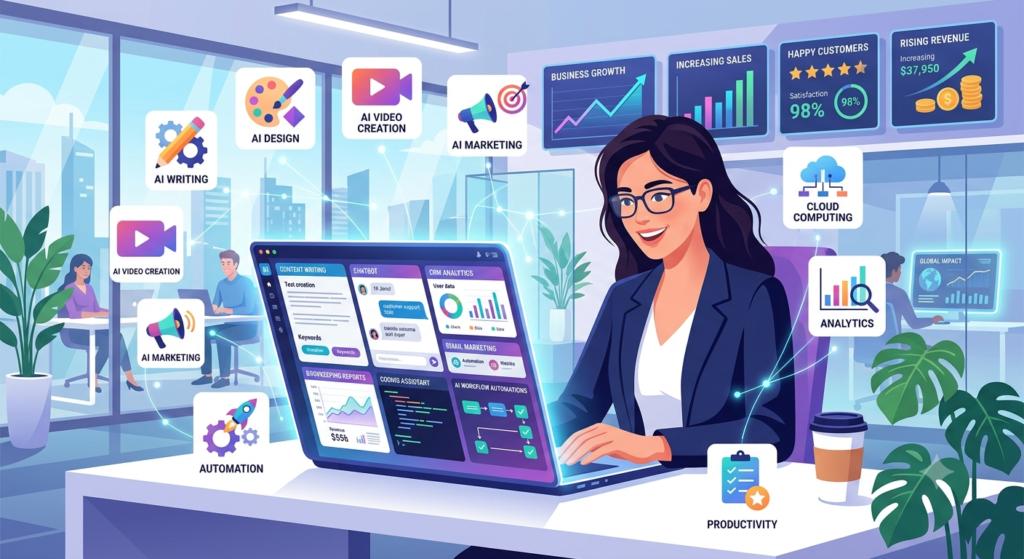
AI for Business: How to Grow Your Business Faster Using AI Tools in 2026 (Complete Beginner’s Guide)
Discover how AI for business can help you save time, increase sales, automate tasks, and grow faster in 2026. Learn the best AI business tools, practical strategies, real-world examples, and mistakes to avoid.
How to Grow Your Business Faster Using AI Tools in 2026
Primary Keyword: AI for business
Secondary Keywords: AI business tools, AI productivity, AI marketing, AI automation, Best AI tools
Imagine having an employee who never sleeps, never gets tired, works 24 hours a day, learns new skills instantly, and costs only a fraction of hiring a full-time team.
That’s exactly what artificial intelligence (AI) has become for modern businesses.
Whether you’re running a small online store, a local bakery, a consulting agency, a freelance business, or a global company, AI is changing how businesses operate.
In 2026, companies that embrace AI aren’t replacing human creativity—they’re removing repetitive work so they can focus on growth, innovation, and customer relationships.
Just a few years ago, only large corporations had access to sophisticated AI technology. Today, powerful AI business tools are available to everyone, many of them completely free or extremely affordable.
Businesses now use AI to:
- Write blog posts
- Design graphics
- Create marketing videos
- Respond to customers
- Send emails
- Build websites
- Analyze sales
- Manage finances
- Schedule appointments
- Generate leads
- Automate repetitive tasks
The result?
More productivity.
Lower costs.
Better customer experiences.
Faster business growth.
In this comprehensive guide, you’ll learn exactly how to use AI for business in 2026, discover the best AI tools for different tasks, avoid common mistakes, and build a smarter business without needing advanced technical skills.
Table of Contents
- What Is AI for Business?
- Why Businesses Are Adopting AI Faster Than Ever
- Benefits of Using AI in Business
- AI Writing Tools
- AI Customer Support
- AI Design Tools
- AI Video Creation
- AI Coding Assistants
- AI Bookkeeping
- AI Email Marketing
- AI CRM Software
- AI Automation
- Best Free AI Tools
- Real-World Business Examples
- AI Mistakes to Avoid
- Comparison Table
- Frequently Asked Questions
- Final Thoughts
What Is AI for Business?
AI for business refers to using artificial intelligence to automate tasks, improve decision-making, increase efficiency, and enhance customer experiences.
Instead of spending hours on repetitive work, AI helps complete tasks in minutes.
Examples include:
- Writing product descriptions
- Answering customer questions
- Creating marketing campaigns
- Generating social media posts
- Designing logos
- Predicting customer behavior
- Managing inventory
- Scheduling meetings
Think of AI as your digital assistant rather than your replacement.
Why Businesses Are Adopting AI Faster Than Ever
Several factors are driving rapid AI adoption:
- Lower software costs
- Better AI accuracy
- Faster internet
- Cloud computing
- Increased competition
- Growing customer expectations
Customers now expect businesses to respond quickly, personalize experiences, and provide instant support.
AI makes this possible—even for small businesses.
Benefits of AI for Business
Save Time
Automation handles repetitive work while your team focuses on strategy.
Example
Instead of replying to 200 customer emails manually, an AI assistant drafts responses in seconds.
Reduce Costs
Businesses can automate tasks that previously required additional employees.
Examples include:
- Data entry
- Scheduling
- Email responses
- Content writing
- Customer support
Increase Productivity
Employees spend less time on repetitive work and more time solving important business problems.
Better Customer Experience
AI chatbots answer questions instantly—even outside business hours.
Improve Marketing Results
AI analyzes customer data and creates personalized campaigns that improve conversions.
AI Writing Tools
Content marketing remains one of the most effective ways to attract customers.
AI writing tools can help create:
- Blog articles
- Product descriptions
- Email newsletters
- Website copy
- Social media captions
- Advertising copy
Popular AI Writing Tools
- ChatGPT
- Claude
- Gemini
- Jasper
- Copy.ai
- Writesonic
Actionable Tips
- Always edit AI-generated content.
- Add your own expertise.
- Include real examples.
- Fact-check important information.
- Match your brand voice.
AI Customer Support
Customers expect instant answers.
AI chatbots provide support 24/7 without hiring a large customer service team.
AI can:
- Answer FAQs
- Track orders
- Schedule appointments
- Handle returns
- Collect customer information
- Escalate complex issues to humans
Benefits
✔ Faster responses
✔ Higher customer satisfaction
✔ Lower support costs
AI Design Tools
Professional design no longer requires years of experience.
AI design software helps create:
- Logos
- Social media graphics
- Flyers
- Presentations
- Advertisements
- Product mockups
Popular tools include:
- Canva AI
- Adobe Firefly
- Microsoft Designer
- Leonardo AI
Actionable Tips
Maintain consistent colors, fonts, and branding across all designs.
AI Video Creation
Video marketing continues to dominate online engagement.
AI video tools can produce:
- YouTube videos
- TikTok content
- Instagram Reels
- Product demonstrations
- Training videos
- Explainer animations
Popular AI video tools include:
- Synthesia
- Pictory
- Runway
- InVideo AI
- HeyGen
Best Practices
- Keep videos concise.
- Add subtitles.
- Use clear calls to action.
- Focus on solving customer problems.
AI Coding
You don’t need to be a professional developer anymore.
AI coding assistants help:
- Write code
- Debug errors
- Build websites
- Create apps
- Automate workflows
- Learn programming
Popular options:
- GitHub Copilot
- Cursor
- Replit AI
- Amazon Q Developer
Even non-technical entrepreneurs can build simple tools using AI.
AI Bookkeeping
Financial management is essential for every business.
AI bookkeeping software automates:
- Expense tracking
- Invoice generation
- Tax calculations
- Financial reports
- Receipt scanning
- Cash flow forecasting
Benefits include:
- Fewer accounting mistakes
- Faster reporting
- Better budgeting
- Improved financial visibility
AI Email Marketing
Email remains one of the highest ROI marketing channels.
AI helps by:
- Writing subject lines
- Personalizing emails
- Segmenting audiences
- Optimizing send times
- Predicting open rates
- Running A/B tests
Popular email platforms now include built-in AI features.
Actionable Tips
- Personalize every email.
- Test multiple subject lines.
- Send value before promotions.
- Monitor click-through rates.
AI CRM (Customer Relationship Management)
Modern CRM systems use AI to help businesses:
- Predict customer purchases
- Recommend follow-ups
- Score leads
- Identify sales opportunities
- Automate reminders
- Improve customer retention
AI helps sales teams spend more time selling and less time on administrative work.
AI Automation
Perhaps the biggest advantage of AI is automation.
Instead of manually completing repetitive tasks, AI workflows connect multiple applications.
Examples include:
- Automatically sending invoices
- Posting social media updates
- Following up with leads
- Updating spreadsheets
- Managing appointments
- Organizing files
Automation saves hundreds of hours each year.
Best Free AI Tools in 2026
| Tool | Best For | Free Version |
| ChatGPT | Writing & brainstorming | Yes |
| Gemini | Research | Yes |
| Claude | Long-form writing | Yes |
| Canva AI | Graphic design | Yes |
| Microsoft Designer | Social graphics | Yes |
| Pictory | Video creation | Limited |
| Notion AI | Productivity | Limited |
| Grammarly | Writing improvement | Yes |
| Perplexity | AI search | Yes |
| Zapier AI | Automation | Limited |
Real-World Examples
Example 1: Small Bakery
A neighborhood bakery uses AI to:
- Schedule Instagram posts
- Respond to customer messages
- Design promotional flyers
- Track inventory
Result:
The owner spends less time on marketing and more time baking.
Example 2: Freelance Designer
A freelancer uses AI to:
- Draft proposals
- Generate invoices
- Schedule meetings
- Create social media content
Result:
More client work with fewer administrative tasks.
Example 3: E-commerce Store
An online store uses AI to:
- Recommend products
- Answer customer questions
- Write product descriptions
- Predict inventory needs
Result:
Higher conversion rates and improved customer satisfaction.
AI Mistakes to Avoid
1. Trusting AI Without Verification
Always review AI-generated content for accuracy.
2. Ignoring Human Creativity
AI supports creativity—it shouldn’t replace your unique voice.
3. Using Too Many AI Tools
Start with a few essential tools before expanding.
4. Forgetting Data Privacy
Choose reputable platforms and protect customer information.
5. Automating Everything
Some interactions still require empathy and human judgment.
6. Neglecting Employee Training
Ensure your team understands how to use AI effectively.
7. Chasing Every New AI Trend
Focus on tools that solve real business problems rather than adopting every new application.
Comparison Table: Traditional Business vs AI-Powered Business
| Business Task | Traditional Method | AI-Powered Method |
| Blog writing | Several hours | Minutes |
| Customer support | Business hours only | 24/7 assistance |
| Graphic design | Professional designer | AI-assisted creation |
| Email marketing | Manual campaigns | Automated personalization |
| Bookkeeping | Manual data entry | Automatic tracking |
| Video creation | Days or weeks | Hours |
| Sales follow-up | Manual reminders | Automated workflows |
| Data analysis | Manual spreadsheets | Instant AI insights |
Actionable Tips to Start Using AI Today
- Identify repetitive tasks that consume the most time.
- Begin with one or two AI tools instead of many.
- Train your team to use AI responsibly.
- Keep a human review process for important outputs.
- Measure time and cost savings to evaluate ROI.
- Automate routine workflows like email follow-ups and scheduling.
- Regularly review new AI features that could benefit your business.
- Protect customer data by choosing trusted AI providers.
- Use AI to enhance—not replace—customer relationships.
- Continuously experiment and refine your AI workflows.
Frequently Asked Questions
Is AI suitable for small businesses?
Yes. Many AI tools are designed specifically for small businesses and offer free or affordable plans.
Do I need technical skills to use AI?
No. Most modern AI platforms are beginner-friendly and require little or no coding knowledge.
Can AI replace employees?
AI is best used to automate repetitive tasks, allowing employees to focus on creative work, strategic planning, and customer relationships.
What is the best AI tool for business?
There isn’t one universal answer. The best tool depends on your goals. For writing, ChatGPT or Claude are excellent choices. For design, Canva AI is popular. For automation, Zapier AI is widely used.
Are free AI tools good enough?
Many free tools are powerful enough for startups and small businesses. As your business grows, paid plans often provide more advanced features and higher usage limits.
Is AI safe for business data?
It can be, provided you use trusted providers, follow security best practices, and avoid sharing sensitive or confidential information unnecessarily.
Conclusion
Artificial intelligence is no longer a futuristic concept reserved for large corporations. In 2026, it has become one of the most practical and affordable ways for businesses of all sizes to work smarter, serve customers better, and grow faster.
From writing content and designing graphics to automating customer support, managing finances, creating videos, and streamlining marketing campaigns, AI enables entrepreneurs to accomplish more with fewer resources. The key is to treat AI as a powerful assistant rather than a replacement for human creativity and strategic thinking.
Start by identifying the repetitive tasks that slow your business down. Choose one or two reliable AI tools, learn how to use them effectively, and measure the results. As you become more comfortable, expand your AI toolkit to cover other areas such as sales, customer service, bookkeeping, and automation.
Businesses that combine human expertise with intelligent AI systems will be better positioned to adapt, innovate, and compete in an increasingly digital marketplace.
By embracing AI thoughtfully and responsibly, you can save valuable time, reduce costs, improve customer experiences, and create a stronger foundation for long-term success.
The future of business belongs to those who are willing to learn, experiment, and use AI to unlock new opportunities. There’s never been a better time to start.
Digital Marketing for Small Business: The Complete Beginner Guide to Growing Your Business Online
