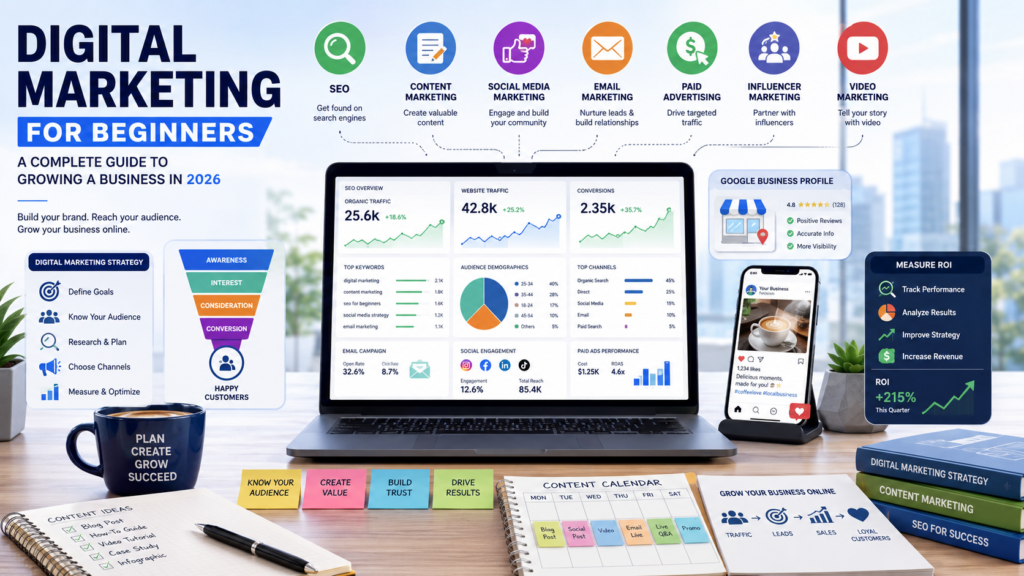
Digital Marketing for Beginners: A Complete Guide to Growing a Business in 2026
Digital marketing for beginners, online marketing, digital marketing strategy, internet marketing, small business marketing
Imagine having a small business with an excellent product, competitive prices, and a service customers genuinely love—but hardly anyone knows you exist.That is the problem digital marketing can solve.
In 2026, customers no longer discover businesses only through billboards, newspapers, television, or word of mouth. They search on Google, watch videos on YouTube, scroll through TikTok and Instagram, compare reviews, read blog posts, open emails, and ask questions before deciding where to spend their money.
This means that even a small business can compete for attention with much larger companies—provided it knows how to market itself online.
The good news is that digital marketing does not require a massive advertising budget. A business can begin with a website, useful content, social media, email marketing, local search optimization, and a well-planned strategy.
The challenge is knowing where to start.
This complete guide to digital marketing for beginners explains the major channels, how they work together, how to create a practical digital marketing strategy, how to measure your return on investment (ROI), and the mistakes beginners should avoid.
Whether you run a startup, local business, online store, personal brand, consultancy, or established company, this guide will help you build a stronger online presence in 2026.
Table of Contents
- What Is Digital Marketing?
- Why Businesses Need Digital Marketing
- Search Engine Optimization (SEO)
- Content Marketing
- Social Media Marketing
- Email Marketing
- Paid Advertising
- Influencer Marketing
- Video Marketing
- Google Business Profile
- How to Create a Digital Marketing Strategy
- How to Measure Digital Marketing ROI
- Common Digital Marketing Mistakes Beginners Make
- A Simple Digital Marketing Plan for Beginners
- Frequently Asked Questions
- Conclusion
What Is Digital Marketing?
Digital marketing is the process of promoting products, services, brands, or businesses through digital channels.
These channels can include:
- Search engines
- Websites
- Blogs
- Social media platforms
- Online advertisements
- Video platforms
- Influencer partnerships
- Mobile applications
- Online marketplaces
Digital marketing is sometimes called online marketing or internet marketing.
Traditional marketing might involve placing an advertisement on a billboard or in a magazine.
Digital marketing, on the other hand, allows businesses to reach people through the devices and platforms they already use every day.
For example, a clothing company could use:
- SEO to appear when people search for clothing online.
- Instagram to showcase products.
- TikTok to create short-form videos.
- Email marketing to announce new collections.
- Google Ads to reach people actively searching for products.
- Influencers to introduce the brand to new audiences.
- Content marketing to educate potential customers.
The strongest marketing strategies usually combine several of these channels instead of relying on only one.
Why Do Businesses Need Digital Marketing?
A business can have an excellent product and still fail if potential customers cannot find it.
Digital marketing helps businesses become more visible, attract potential customers, build relationships, and generate sales.
1. Customers Are Online
People use search engines, social media, websites, email, and video platforms to discover information and products.
If your business does not have a digital presence, you may be invisible to potential customers who are searching for what you offer.
2. It Can Be More Cost-Effective
Traditional advertising can require significant upfront investment.
Digital marketing gives businesses more flexibility.
A small business can start with organic SEO, social media content, email marketing, and other relatively low-cost strategies before investing heavily in advertising.
3. You Can Target Specific Audiences
Online advertising allows businesses to target audiences based on factors such as:
- Location
- Interests
- Search behavior
- Demographics
- Previous interactions
- Website activity
This can make advertising more precise than many traditional marketing methods.
4. Results Can Be Measured
One major advantage of internet marketing is measurement.
Businesses can track:
- Website visitors
- Leads
- Sales
- Clicks
- Conversion rates
- Advertising costs
- Email opens
- Social engagement
This information allows marketers to determine what is working and what needs improvement.
SEO: Getting Found on Search Engines
Search engine optimization, commonly known as SEO, is one of the most important parts of digital marketing.
SEO involves improving your website and content so that search engines can better understand and rank your pages for relevant searches.
For example, suppose you own a bakery in London.
A potential customer searches:
“best birthday cakes in London.”
If your website has useful, well-optimized content about birthday cakes and your business has strong local SEO signals, you may have an opportunity to appear in search results.
Important SEO Areas
Keyword Research
Find phrases your potential customers are actually searching for.
Examples include:
- digital marketing for beginners
- best email marketing software
- how to start a small business
- affordable accounting software
- marketing ideas for small businesses
On-Page SEO
Optimize elements such as:
- Page titles
- Headings
- URLs
- Meta descriptions
- Internal links
- Image alt text
- Content structure
Technical SEO
Make sure your website is:
- Fast
- Mobile-friendly
- Secure
- Easy for search engines to crawl
- Properly structured
Off-Page SEO
Build credibility through:
- Relevant backlinks
- Digital PR
- Industry mentions
- Partnerships
- High-quality references
SEO is not usually an overnight strategy. It can take time, but strong content can continue attracting visitors long after publication.
Content Marketing
Content marketing involves creating useful content that attracts and educates your target audience.
Instead of constantly telling people, “Buy our product,” you provide information that helps them solve problems.
Content can include:
- Blog articles
- Guides
- Tutorials
- Case studies
- Infographics
- Videos
- Podcasts
- Ebooks
- Checklists
- Social media posts
For example, a financial consulting company might publish:
“How to Create a Business Budget in 2026.”
Someone searching for that information may discover the company’s website.
That visitor could eventually become a subscriber, lead, or customer.
The Content Marketing Funnel
A useful way to think about content is:
Awareness → Consideration → Conversion → Retention
At the awareness stage, create educational content.
At the consideration stage, publish comparisons, case studies, and detailed guides.
At the conversion stage, provide product demonstrations, testimonials, pricing information, or consultations.
After the customer purchases, use helpful content and email communication to encourage retention.
Social Media Marketing
Social media marketing involves promoting your business and building relationships through platforms such as Instagram, Facebook, TikTok, LinkedIn, YouTube, Pinterest, and other relevant networks.
You do not necessarily need to be everywhere.
Instead, focus on the platforms where your target audience spends time.
For example:
| Business | Potentially Useful Platforms |
| B2B software | LinkedIn, YouTube |
| Fashion brand | Instagram, TikTok, Pinterest |
| Restaurant | Instagram, TikTok, Facebook |
| Consultant | LinkedIn, YouTube |
| E-commerce brand | Instagram, TikTok, Pinterest |
| Local service business | Facebook, Instagram, Google |
What Should You Post?
Consider creating:
- Educational content
- Behind-the-scenes content
- Customer stories
- Product demonstrations
- Tutorials
- Short videos
- Frequently asked questions
- Industry insights
- User-generated content
The goal isn’t simply to collect followers.
The goal is to build an audience that trusts your business and eventually takes meaningful actions.
Email Marketing
Email marketing remains one of the most useful digital marketing channels because it allows businesses to communicate directly with people who have voluntarily joined their audience.
You can use email to send:
- Newsletters
- Product announcements
- Special offers
- Educational content
- Welcome sequences
- Abandoned-cart reminders
- Event invitations
- Customer updates
A basic email funnel might look like:
Visitor → Email subscriber → Engaged subscriber → Customer → Repeat customer
One important beginner mistake is buying email lists.
Instead, build an audience through legitimate opt-in methods such as website forms, lead magnets, registrations, and purchases.
Paid Advertising
Paid advertising allows businesses to pay for exposure across digital platforms.
Common options include:
- Search advertising
- Display advertising
- Social media advertising
- Video advertising
- Shopping advertising
- Retargeting campaigns
For example, Google Search Ads can help a business appear when potential customers search for specific commercial keywords.
Paid advertising can generate traffic faster than SEO, but it requires careful management.
A campaign that receives thousands of clicks is not necessarily successful if those clicks do not produce customers.
Always monitor the relationship between:
Advertising spend → Leads → Customers → Revenue
Influencer Marketing
Influencer marketing involves partnering with individuals who have an established audience.
The right influencer isn’t necessarily the person with the largest following.
For many businesses, audience relevance and trust are more important than follower count.
For example, a skincare company might work with a beauty creator whose audience is interested in skincare.
A local restaurant could collaborate with food creators in its city.
Before working with an influencer, consider:
- Audience demographics
- Engagement quality
- Content style
- Reputation
- Audience location
- Previous partnerships
- Conversion potential
Ask for evidence when possible instead of judging an influencer solely by follower count.
Video Marketing
Video has become an important part of modern digital marketing.
Businesses can use video to demonstrate products, educate customers, tell stories, answer questions, and build brand awareness.
Examples include:
- YouTube tutorials
- TikTok videos
- Instagram Reels
- Product demonstrations
- Customer testimonials
- Educational videos
- Behind-the-scenes videos
- Webinars
You don’t always need expensive equipment.
A smartphone, good lighting, clear audio, and useful information can be enough to begin.
One practical strategy is to turn one long piece of content into multiple smaller pieces.
For example:
One blog post → YouTube video → 5 short videos → Instagram carousel → LinkedIn post → Email newsletter
This is called content repurposing.
Google Business Profile
If you operate a local business, your Google Business Profile should be part of your digital marketing strategy.
It can help customers discover important information about your business when searching online.
Depending on the business and Google’s features, customers may be able to find:
- Business location
- Opening hours
- Phone number
- Website
- Reviews
- Photos
- Services
- Products
- Directions
For a local business, this can be extremely valuable.
For example, imagine someone searches:
“coffee shop near me.”
A well-maintained local business presence can help your business appear when nearby customers are looking for relevant services.
Keep your business information accurate and encourage genuine customers to leave honest reviews.
How to Create a Digital Marketing Strategy
Randomly posting on social media isn’t a strategy.
A digital marketing strategy should connect your marketing activities to specific business objectives.
Here’s a simple framework.
Step 1: Define Your Goal
Start with a measurable objective.
Examples:
- Generate 100 leads per month.
- Increase online sales by 20%.
- Generate 500 new email subscribers.
- Increase organic website traffic.
- Get more local customers.
Avoid vague goals such as “get more followers.”
Step 2: Identify Your Target Audience
Ask:
- Who is the customer?
- What problem do they have?
- What are they trying to achieve?
- What websites do they use?
- What social platforms do they prefer?
- What questions do they ask?
- What prevents them from purchasing?
The better you understand your customer, the easier it becomes to create relevant marketing.
Step 3: Study Competitors
Look at competitors’:
- Websites
- SEO strategies
- Social media
- Content
- Reviews
- Advertising
- Offers
- Customer experience
Don’t simply copy them.
Instead, identify gaps you can exploit.
Step 4: Choose Your Channels
You don’t need ten marketing channels.
Start with two or three that match your audience.
For example:
Local business:
SEO + Google Business Profile + social media
B2B company:
SEO + content marketing + LinkedIn + email
E-commerce brand:
SEO + social media + video + paid advertising + email
Step 5: Create a Content Calendar
Plan your content ahead of time.
Your calendar might include:
| Day | Content |
| Monday | Educational blog post |
| Tuesday | Short-form video |
| Wednesday | Customer story |
| Thursday | Educational social post |
| Friday | Product demonstration |
| Saturday | Behind-the-scenes content |
| Sunday | Email newsletter |
Consistency makes marketing easier to manage.
Step 6: Test and Improve
Your first strategy won’t be perfect.
Track results, identify what works, and make improvements.
Digital marketing is an ongoing process rather than a one-time project.
How to Measure Digital Marketing ROI
ROI means return on investment.
A basic ROI formula is:
ROI = (Revenue − Marketing Cost) ÷ Marketing Cost × 100
For example, suppose a business spends $1,000 on a campaign and generates $3,000 in attributable revenue.
ROI:
($3,000 − $1,000) ÷ $1,000 × 100 = 200%
That means the campaign generated a 200% return based on this simplified calculation.
However, not every marketing result is immediately connected to revenue.
You should also monitor metrics such as:
Website Metrics
- Organic traffic
- Conversion rate
- Bounce or engagement metrics
- Landing-page performance
- Returning visitors
Advertising Metrics
- Cost per click
- Cost per lead
- Conversion rate
- Customer acquisition cost
- ROAS
Email Metrics
- Open rate
- Click-through rate
- Conversion rate
- Unsubscribe rate
- Revenue per campaign
Social Media Metrics
- Engagement
- Reach
- Website clicks
- Leads
- Sales
The most important metric depends on your business objective.
Common Digital Marketing Mistakes Beginners Make
1. Trying to Be Everywhere
Managing every social platform at once can lead to poor-quality content.
Start with the channels that matter most.
2. Focusing Only on Followers
A large audience doesn’t automatically equal revenue.
A smaller audience with strong buying intent can be more valuable.
3. Ignoring SEO
Businesses sometimes spend heavily on social media while ignoring people actively searching for their products.
SEO should be considered part of your long-term strategy.
4. Creating Content Without a Purpose
Every piece of content should have a reason.
Ask:
What should the reader or viewer do after consuming this content?
5. Expecting Immediate Results
SEO, content marketing, email lists, and organic social media can take time.
Don’t abandon a good strategy simply because it doesn’t produce results overnight.
6. Not Tracking Results
If you don’t measure your campaigns, you won’t know where your money is going.
7. Targeting Everyone
Trying to market to everyone usually makes your message less compelling.
Define a specific audience.
8. Selling Too Aggressively
People don’t want every interaction to feel like an advertisement.
Educate, entertain, solve problems, and build trust alongside selling.
A Simple Digital Marketing Plan for Beginners
If you’re completely new to online marketing, don’t try to implement everything simultaneously.
Use this simple 90-day framework.
Days 1–30: Build Your Foundation
- Define your target customer.
- Create or improve your website.
- Set up analytics and measurement.
- Research keywords.
- Create or optimize your Google Business Profile if applicable.
- Establish your social media profiles.
- Create your first content calendar.
Days 31–60: Start Publishing
- Publish useful SEO content.
- Create short-form videos.
- Build an email list.
- Start sending newsletters.
- Improve your website’s conversion points.
- Test different social content formats.
Days 61–90: Optimize
Review your results.
Identify:
- Your highest-performing content.
- Your best traffic sources.
- Your highest-converting pages.
- Your strongest social posts.
- Your most effective emails.
- Your best-performing advertisements, if applicable.
Then invest more time and money into what is working.
Real-World Example: A Small Local Business
Imagine a small restaurant called Green Bowl Kitchen.
Instead of relying only on walk-in customers, the restaurant creates a digital marketing strategy.
It:
- Creates a Google Business Profile.
- Encourages genuine customers to leave reviews.
- Publishes a website menu.
- Creates blog content about healthy meals.
- Posts short cooking videos.
- Builds an Instagram presence.
- Collects customer emails with permission.
- Sends occasional promotions.
- Runs targeted local advertising.
- Tracks reservations and online orders.
The restaurant is no longer relying on a single source of customers.
Its marketing system works across search, social media, email, video, and paid advertising.
That is the real power of digital marketing.
Frequently Asked Questions
What is digital marketing in simple terms?
Digital marketing is promoting a business, product, service, or brand through online channels such as search engines, websites, social media, email, videos, and digital advertising.
Is digital marketing good for beginners?
Yes. Beginners can start with relatively simple strategies such as creating useful content, improving SEO, building social media profiles, collecting email subscribers, and optimizing their local online presence.
How much does digital marketing cost?
There is no single price.
A business can start with organic strategies at a relatively low cost or spend thousands of dollars on professional services and advertising.
The appropriate budget depends on the business, audience, competition, goals, and marketing channels.
How long does digital marketing take to work?
It depends on the channel.
Paid advertising can generate traffic quickly, while SEO and content marketing often require more time to build momentum.
Consistency and optimization are important.
What is the best digital marketing strategy?
There is no universal strategy.
The best approach depends on your target audience and business model.
A local restaurant may benefit from local SEO, Google Business Profile, social media, and video.
A B2B software company may prioritize SEO, content marketing, LinkedIn, email, and webinars.
Can a small business compete with large companies?
Yes.
Small businesses can compete by targeting specific audiences, providing excellent customer experiences, producing highly relevant content, focusing on local SEO, and finding underserved niches.
Is SEO better than paid advertising?
Neither is universally better.
SEO can provide long-term organic visibility, while paid advertising can provide faster exposure.
Many businesses benefit from using both.
Do I need a website for digital marketing?
A website isn’t required for every marketing activity, but having a professional website gives a business a central online destination that it controls.
It can also support SEO, content marketing, lead generation, ecommerce, and conversions.
Conclusion: Start Small, Measure Everything, and Keep Improving
Digital marketing can look overwhelming when you see all the available channels.
SEO.
Content marketing.
Social media.
Email.
Video.
Influencers.
Paid advertising.
Local search.
Analytics.
But you don’t need to master everything at once.
The smartest approach is to build a system gradually.
Start by understanding your customer. Create a strong online foundation. Choose the channels that actually reach your audience. Publish useful content consistently. Build relationships instead of constantly pushing sales. Track your results and use the data to improve.
Most importantly, remember that digital marketing is not simply about getting attention—it is about turning attention into trust, trust into customers, and customers into long-term business growth.
In 2026, businesses have more opportunities than ever to reach potential customers online.
You don’t need the biggest budget.
You don’t need millions of followers.
You don’t need to be on every platform.
You need a clear audience, a useful offer, a consistent message, and a digital marketing strategy that you are willing to test and improve.
Start with one channel.
Learn it.
Measure it.
Improve it.
Then expand.
That is how beginners can turn digital marketing from a confusing collection of online tools into a predictable engine for business growth.
