Social Media Marketing for Small Business: 2026 Strategy
Learn social media marketing for small business in 2026. Discover platforms, content strategies, Reels, engagement, analytics, paid ads, and ways to turn followers into customers.
Running a small business in 2026 without a social media presence is a little like opening a shop on a busy street and keeping the lights off.
Your potential customers are already scrolling through Instagram, Facebook, TikTok, YouTube, and other platforms every day. They are discovering brands, comparing products, watching reviews, asking for recommendations, and making purchases—all from their phones.
The good news? You don’t need millions of followers to benefit from social media marketing.
A small business with 2,000 engaged followers can sometimes generate more sales than a brand with 100,000 followers if those followers actually trust the business and want what it sells.
That’s why social media marketing for small business isn’t simply about posting pretty pictures or chasing viral trends. It’s about building visibility, developing relationships, creating useful content, and moving people from “I’ve never heard of this business” to “I want to buy from them.”
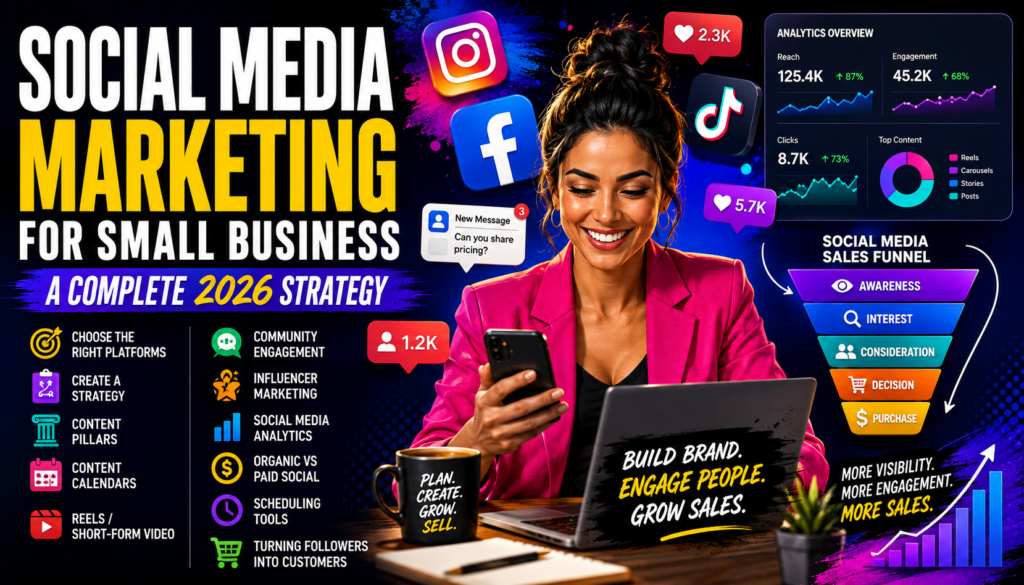
This complete 2026 strategy will show you how to choose the right platforms, create a practical social media strategy, develop content pillars, use short-form video, engage your community, work with influencers, analyze your results, and ultimately turn followers into customers.
Table of Contents
- What Is Social Media Marketing for Small Business?
- Why Social Media Marketing Matters for Small Businesses
- Choose the Right Social Media Platforms
- Create a Social Media Strategy
- Build Strong Content Pillars
- Create a Social Media Content Calendar
- Use Reels and Short-Form Video
- Focus on Community Engagement
- Try Influencer Marketing
- Track Social Media Analytics
- Organic vs. Paid Social Media
- Use Social Media Scheduling Tools
- Turn Followers Into Customers
- Common Social Media Marketing Mistakes
- A Simple 30-Day Social Media Plan
- Frequently Asked Questions
- Final Thoughts
What Is Social Media Marketing for Small Business?
Social media marketing for small business is the process of using social media platforms to promote a business, build relationships with customers, increase brand awareness, generate leads, and drive sales.
Instead of relying entirely on traditional advertising, businesses can use platforms such as Instagram, Facebook, TikTok, YouTube, LinkedIn, Pinterest, or X to reach potential customers where they already spend their time.
Social media marketing can include:
- Educational posts
- Product demonstrations
- Short-form videos
- Customer testimonials
- Behind-the-scenes content
- Promotional offers
- Live videos
- Polls and questions
- Influencer collaborations
- Paid advertisements
- Community discussions
The important thing is that social media shouldn’t operate separately from your business.
Your social media content should support your larger goals—whether that’s getting more website visitors, generating leads, receiving bookings, selling products, building an email list, or increasing local awareness.
Why Social Media Marketing Matters for Small Businesses
Small businesses often face a major disadvantage compared with large corporations: limited advertising budgets.
A multinational company might spend millions on advertising. A small business may have only a few hundred dollars—or less—to invest in marketing.
Social media helps level the playing field.
You can create a useful video with a smartphone, publish it for free, and potentially reach thousands of people.
More importantly, social media allows businesses to build relationships rather than simply broadcast advertisements.
Imagine a small skincare business.
Instead of posting:
“BUY OUR NEW SKINCARE PRODUCT!”
the business could create videos showing:
- How to build a basic skincare routine
- Common skincare mistakes
- How to identify dry skin
- How to apply moisturizer correctly
- Customer before-and-after stories
- Behind-the-scenes product packaging
The business is no longer simply selling a product.
It’s becoming a useful source of information.
And useful brands are easier to trust.
Choose the Right Social Media Platforms
One of the biggest mistakes small businesses make is trying to be everywhere.
You don’t necessarily need Instagram, Facebook, TikTok, YouTube, LinkedIn, Pinterest, and X.
You need the platforms where your potential customers actually spend time.
Social Media Platform Comparison
| Platform | Best For | Strong Content Types | Suitable Businesses |
| Visual discovery and community | Reels, Stories, carousels | Fashion, beauty, food, lifestyle | |
| Communities and local customers | Posts, videos, groups | Local businesses, services | |
| TikTok | Discovery and entertainment | Short-form video | Retail, beauty, education, entertainment |
| YouTube | Education and search | Long-form and Shorts | Tutorials, technology, education |
| Professional audiences | Articles, posts, videos | B2B, consulting, software | |
| Visual search | Pins, guides, graphics | Fashion, home, food, DIY |
How to Choose Your Platforms
Ask yourself three questions:
1. Where are my customers?
If your target audience isn’t using a platform, don’t spend most of your time there.
2. What type of content can I consistently create?
If you’re comfortable making videos, TikTok, Instagram Reels, and YouTube Shorts could be powerful.
If you prefer writing, LinkedIn or Facebook may be easier.
3. What is my business goal?
Different platforms can serve different purposes.
For example:
- Instagram → brand awareness
- TikTok → discovery
- Facebook → community and local customers
- LinkedIn → B2B leads
- YouTube → education and search traffic
Start with one or two platforms and expand when your system becomes manageable.
Create a Social Media Strategy
Posting randomly isn’t a strategy.
A strong social media strategy begins with a clear objective.
Instead of saying:
“I want more followers.”
create a measurable goal.
For example:
- Generate 100 leads in 90 days
- Increase website traffic by 30%
- Get 20 new customers each month
- Generate 50 product inquiries
- Build an email list of 1,000 subscribers
Your goal determines what you post.
Define Your Target Customer
Before creating content, understand who you’re trying to reach.
Consider:
- Age
- Location
- Occupation
- Interests
- Problems
- Buying habits
- Budget
- Goals
- Questions they frequently ask
For example, instead of targeting “women,” a fashion business could target:
Women aged 22–35 who want affordable workwear and regularly shop online.
That’s much easier to create content for.
Define Your Brand Voice
Your brand might sound:
- Friendly
- Professional
- Educational
- Funny
- Inspirational
- Luxurious
- Casual
Choose a tone that fits both your audience and your business.
Build Strong Content Pillars
Content pillars are the main topics your business repeatedly creates content around.
They prevent you from staring at your phone every morning wondering:
“What am I supposed to post today?”
A small business might use four or five content pillars.
Example: Fitness Business
Pillar 1: Education
- Workout tips
- Nutrition basics
- Exercise tutorials
Pillar 2: Transformation
- Customer stories
- Progress updates
- Testimonials
Pillar 3: Behind the Scenes
- Training sessions
- Staff introductions
- Daily operations
Pillar 4: Products and Services
- Memberships
- Classes
- Personal training
Pillar 5: Personality
- Fitness myths
- Funny gym moments
- Questions and polls
This creates variety without losing focus.
A Simple Content Pillar Formula
Try:
40% educational content
20% entertaining content
20% community/social-proof content
20% promotional content
The exact percentages aren’t a universal rule, but the principle is useful: don’t make every post a sales pitch.
Create a Social Media Content Calendar
A content calendar turns social media from a daily headache into a repeatable system.
You don’t need a complicated spreadsheet.
Even a simple weekly schedule can work.
Example Weekly Calendar
| Day | Content |
| Monday | Educational Reel |
| Tuesday | Customer testimonial |
| Wednesday | Behind-the-scenes content |
| Thursday | Educational carousel |
| Friday | Product/service video |
| Saturday | Community question |
| Sunday | Story, recap, or personal content |
You can also batch your content.
Instead of creating one video every day, record five or ten videos during one session.
Then edit and schedule them throughout the week.
This can save enormous amounts of time.
Use Reels and Short-Form Video
Short-form video remains one of the most important content formats for businesses trying to increase organic reach.
Platforms such as Instagram and TikTok are designed around discovering content from accounts users may not already follow.
That creates an opportunity for small businesses.
You don’t need a huge audience to get discovered.
What Should You Post?
Try videos such as:
Tutorials
“How to style one dress three ways.”
Before and After
Show the transformation created by your product or service.
Behind the Scenes
Show how your product is made.
Educational Videos
Answer common customer questions.
Product Demonstrations
Show your product being used.
Mistakes
“3 mistakes people make when choosing running shoes.”
Frequently Asked Questions
Turn customer questions into videos.
Customer Stories
Let customers explain their experience.
The Hook Matters
The first few seconds need to give viewers a reason to continue watching.
Instead of:
“Hi everyone, today we’re going to talk about skincare.”
try:
“If your skincare routine isn’t working, you might be making one of these three mistakes.”
The second version creates curiosity immediately.
Focus on Community Engagement
Social media isn’t a billboard.
It’s social.
That means your business shouldn’t simply publish content and disappear.
Respond to:
- Comments
- Direct messages
- Mentions
- Questions
- Reviews
- Story replies
You can also proactively engage with relevant accounts.
For example, a local restaurant could interact with:
- Local food creators
- Nearby businesses
- Community pages
- Local events
- Customers
This helps make the business feel like part of the community rather than a faceless company.
Try the 15-Minute Engagement Routine
Spend 15 minutes each day:
5 minutes: Reply to your comments.
5 minutes: Respond to messages.
5 minutes: Engage with relevant accounts.
Consistency matters more than spending three hours online once a week.
Try Influencer Marketing
Influencer marketing isn’t limited to celebrities.
For small businesses, micro-influencers and nano-influencers can sometimes be more practical because they often have highly specific audiences.
For example, a small beauty brand might collaborate with a beauty creator who has 8,000 highly engaged followers rather than a celebrity with several million followers.
The goal isn’t simply follower count.
Look at:
- Audience relevance
- Engagement
- Content quality
- Trust
- Location
- Previous brand partnerships
- Audience demographics
Example
Imagine a local restaurant wants to attract young professionals.
Instead of paying a massive celebrity to post one picture, the restaurant could work with several local food creators who regularly review restaurants in the area.
Those creators already have audiences interested in local dining.
That’s targeted marketing.
Track Your Social Media Analytics
Likes are nice.
But likes don’t necessarily pay your bills.
A good social media strategy tracks metrics connected to your business goals.
Important metrics include:
Reach
How many people saw your content?
Engagement
How many people interacted with it?
Engagement Rate
How much interaction did your content generate relative to its reach or audience?
Website Clicks
How many people visited your website?
Leads
How many people expressed interest?
Conversion Rate
How many visitors became customers?
Revenue
How much money did your social media activity generate?
A post with 20,000 views and zero customers isn’t necessarily better than a post with 2,000 views that generates 15 sales.
Always connect social media performance to your actual business objectives.
Organic vs Paid Social Media
Small businesses can use both organic and paid social media.
Organic Social
Organic content is unpaid content published naturally on your account.
Examples include:
- Reels
- Posts
- Stories
- TikToks
- YouTube Shorts
- Community engagement
Advantages:
- Low financial cost
- Builds relationships
- Can create long-term visibility
- Helps establish credibility
Disadvantages:
- Requires consistency
- Reach isn’t guaranteed
- Growth can take time
Paid Social
Paid social involves paying platforms to distribute advertisements.
Examples include:
- Product advertisements
- Lead generation campaigns
- Website traffic campaigns
- Retargeting
- Promotional campaigns
Advantages:
- Faster reach
- Precise targeting
- Scalable
- Measurable
Disadvantages:
- Requires budget
- Poor campaigns can waste money
- Requires testing and optimization
Organic vs Paid Social Comparison
| Feature | Organic | Paid |
| Cost | Usually free | Requires advertising budget |
| Speed | Slower | Faster |
| Reach | Algorithm-dependent | Can be purchased |
| Trust | Often stronger over time | Depends on creative |
| Targeting | Limited | Advanced |
| Best For | Community and brand building | Leads, sales, campaigns |
For many small businesses, combining both approaches is ideal.
Use organic content to build trust and paid campaigns to amplify successful offers or reach specific audiences.
Use Social Media Scheduling Tools
Scheduling tools can make social media management much easier.
Instead of manually publishing content every day, you can prepare posts in advance.
A scheduling workflow might look like this:
Monday: Create content.
Tuesday: Edit videos.
Wednesday: Write captions.
Thursday: Schedule posts.
Friday: Review analytics.
This creates a system instead of relying on motivation.
When choosing a scheduling tool, look for features such as:
- Multi-platform publishing
- Content calendars
- Analytics
- Team collaboration
- Caption management
- Scheduling
- Mobile access
The goal isn’t to automate everything.
You still need to respond to people and participate in conversations.
Turn Followers Into Customers
This is where many businesses get social media wrong.
They focus so heavily on gaining followers that they forget the purpose of marketing.
The ultimate objective is usually not:
“Get more followers.”
It’s:
“Get the right people to take the right action.”
That action could be:
- Buy a product
- Book an appointment
- Request a quote
- Join an email list
- Download a guide
- Visit a store
- Contact the business
Build a Clear Customer Journey
A simple customer journey can look like:
Discovery → Interest → Trust → Action → Purchase → Loyalty
Stage 1: Discovery
A person sees your Reel.
Stage 2: Interest
They visit your profile.
Stage 3: Trust
They watch your educational videos and read customer reviews.
Stage 4: Action
They click your website link.
Stage 5: Purchase
They buy your product.
Stage 6: Loyalty
They follow you, purchase again, and recommend your business.
Your social media content should help people move through these stages.
Use Strong Calls to Action
Don’t assume people automatically know what to do next.
Tell them.
Examples:
- “Visit the link in our bio.”
- “Send us a DM for pricing.”
- “Book your appointment today.”
- “Save this post for later.”
- “Comment your favorite.”
- “Join our email list.”
- “Shop the collection.”
A call to action turns passive attention into measurable action.
Common Social Media Marketing Mistakes
1. Trying to Be Everywhere
Focus on the platforms that matter most.
2. Posting Only Promotional Content
People don’t follow businesses because they want advertisements all day.
Teach, entertain, inspire, and help.
3. Buying Followers
Fake followers can damage engagement and provide little business value.
4. Ignoring Comments
If customers take time to interact with your business, respond.
5. Obsessing Over Viral Content
A viral post isn’t automatically a successful marketing campaign.
Relevant attention is more valuable than random attention.
6. Not Tracking Results
If you don’t measure performance, you don’t know what’s working.
7. Giving Up Too Early
Social media often requires experimentation.
Your first 20 posts may not perform spectacularly.
Use them as data.
A Simple 30-Day Social Media Plan
If you’re starting from scratch, don’t overcomplicate it.
Week 1: Build the Foundation
- Choose your primary platform
- Optimize your profile
- Define your target customer
- Choose 4–5 content pillars
- Set your business goal
Week 2: Start Publishing
Create:
- 3 educational posts
- 2 short-form videos
- 1 promotional post
- Daily Stories where appropriate
Begin responding to comments and messages.
Week 3: Experiment
Test different:
- Hooks
- Video lengths
- Topics
- Posting times
- Calls to action
- Content formats
Don’t worry about perfection.
You are collecting data.
Week 4: Analyze
Identify:
- Best-performing content
- Worst-performing content
- Most engaging topics
- Highest-clicking posts
- Most effective calls to action
Then create more of what worked.
Real-World Example: A Small Fashion Business
Imagine a small fashion brand selling affordable dresses.
Instead of posting product photos every day, the business creates five content pillars:
Education: How to style different body types.
Inspiration: Outfit ideas.
Entertainment: Fashion trends and relatable jokes.
Social Proof: Customer photos and reviews.
Sales: New arrivals and promotions.
The business posts short videos showing different ways to style one dress.
One video receives significantly more views than usual.
Instead of simply celebrating the views, the business examines the topic.
It discovers that customers are particularly interested in styling tips.
The business then creates 10 more videos around styling.
This is how social media becomes a marketing system.
The brand isn’t simply hoping something goes viral.
It’s using data to understand what its audience wants.
Frequently Asked Questions
Is social media marketing effective for small businesses?
Yes. Social media can help small businesses build awareness, communicate with customers, generate leads, drive website traffic, and increase sales. Results depend on factors such as audience, industry, content quality, consistency, offer, and execution.
Which social media platform is best for small businesses?
There isn’t one platform that is best for every business. Instagram and TikTok can be particularly useful for visual and consumer-focused brands, Facebook can be valuable for communities and local businesses, LinkedIn can work well for B2B companies, and YouTube is powerful for educational content.
The best platform is the one where your customers are active and where you can consistently create useful content.
How often should a small business post on social media?
Consistency is more important than posting an extreme amount of content.
A business could start with three to five quality posts per week and adjust based on its resources and results.
Do small businesses need to pay for social media advertising?
No. You can begin with organic content.
However, paid advertising can help businesses reach specific audiences faster once they have a strong offer and content that performs well.
How long does social media marketing take to produce results?
There is no universal timeline. Some content can generate results immediately, while building a recognizable brand and loyal community can take months.
Businesses should focus on consistent execution and continuous improvement rather than expecting overnight success.
Should I buy followers?
No.
Follower numbers are much less useful when the followers aren’t interested in your business. Focus on attracting genuine people who could realistically become customers.
What should I post if I have no content ideas?
Start with your customers’ questions.
Every question you answer through email, customer service, WhatsApp, comments, or conversations can potentially become a social media post.
You can also create tutorials, demonstrations, FAQs, testimonials, behind-the-scenes content, industry tips, and product comparisons.
Can social media actually increase sales?
Yes, but social media shouldn’t be treated as a guaranteed sales machine.
A successful system connects content with a clear offer, strong calls to action, an easy purchasing process, customer trust, and measurement.
Final Thoughts: Build a Social Media Strategy That Sells
Social media marketing for small business doesn’t require a huge advertising budget, expensive equipment, or millions of followers.
What it requires is a clear strategy.
Choose the platforms where your customers actually spend time. Create content around consistent pillars. Use short-form video to increase discovery. Respond to your community.
Experiment with influencers. Study your analytics. Combine organic content with paid advertising when it makes sense.
Most importantly, stop measuring success only by followers and likes.
A smaller audience that trusts your business can be far more valuable than a massive audience that never buys anything.
Think of social media as a journey.
Someone discovers your business through a video.
They become interested because your content helps them.
They begin trusting you because you consistently provide value.
They eventually click your website, send a message, book a service, or make a purchase.
Then, if you deliver a great experience, they come back—and may even recommend you to someone else.
That’s the real power of social media marketing.
You don’t need to become the biggest account on the internet.
You need to become useful, recognizable, trustworthy, and memorable to the people who are most likely to become your customers.
And in 2026, that’s a strategy almost any small business can start building today.
