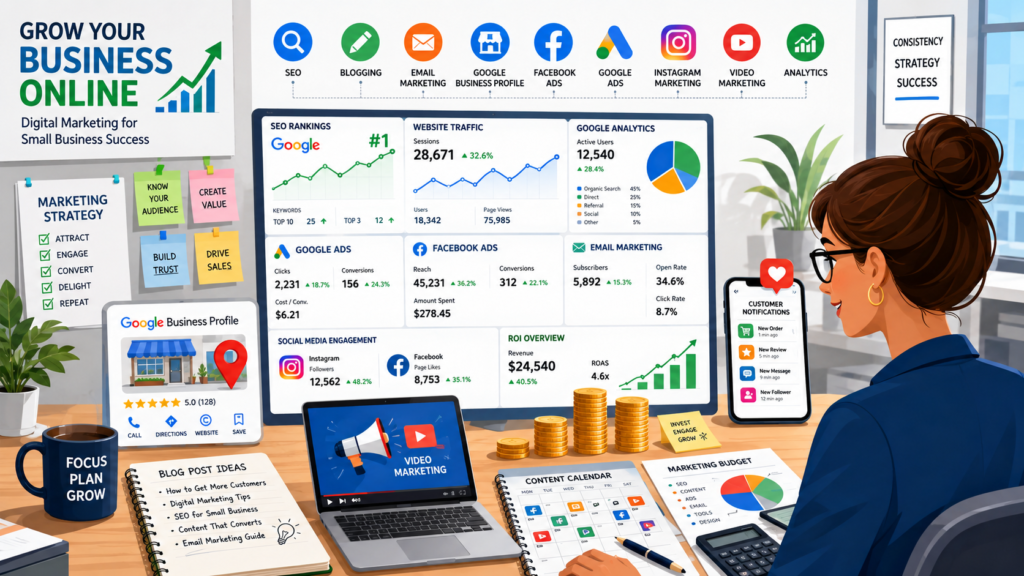
Digital Marketing for Small Business: The Complete Beginner Guide to Growing Your Business Online
Learn everything about digital marketing for small business, including SEO, blogging, email marketing, Google Business Profile, Facebook Ads, Google Ads, Instagram marketing, content marketing, video marketing, analytics, and budgeting in this complete beginner-friendly guide.
Digital Marketing for Small Businesses: Complete Beginner Guide
Imagine opening the doors to your business every morning, but instead of waiting for customers to walk in, thousands of potential buyers are already searching for products or services exactly like yours online.
That’s the power of digital marketing for small business.Years ago, only large corporations could afford television commercials, billboards, and newspaper advertisements.
Today, the internet has completely changed the playing field. A small local bakery can compete with national brands through Google searches. A one-person consulting business can attract international clients through LinkedIn.
A handmade jewelry store can generate thousands of sales using Instagram and Facebook.
Digital marketing isn’t just about posting on social media. It’s about creating a complete system that consistently brings visitors, converts them into customers, and keeps them coming back.
Whether you own a physical store, an online business, a freelance service, or you’re planning to launch your first startup, learning online marketing is one of the most valuable investments you can make.
In this comprehensive guide, you’ll learn exactly how beginners can use digital marketing to grow a business without wasting money on ineffective strategies.
Table of Contents
- What Is Digital Marketing?
- Why Digital Marketing Matters for Small Businesses
- Understanding Your Target Audience
- Build a Professional Website
- Search Engine Optimization (SEO)
- Blogging for Business Growth
- Google Business Profile
- Social Media Marketing
- Instagram Marketing
- Facebook Advertising
- Google Ads
- Email Marketing
- Content Marketing
- Video Marketing
- Website Analytics
- Creating a Marketing Budget
- Common Mistakes Beginners Make
- Actionable Tips
- Real-World Examples
- Comparison Table
- Frequently Asked Questions
- Conclusion
What Is Digital Marketing?
Digital marketing for small business refers to promoting products or services using digital channels such as:
- Google Search
- Websites
- Blogs
- YouTube
- TikTok
- Google Ads
- Online directories
Instead of relying only on traditional advertising, businesses use online platforms to reach customers where they already spend most of their time.
Digital marketing focuses on:
- Increasing visibility
- Building trust
- Generating leads
- Making sales
- Retaining customers
Why Digital Marketing Matters for Small Businesses
Small businesses often operate with limited budgets. Digital marketing allows them to compete with larger companies at a fraction of the cost.
Benefits include:
- Lower marketing costs
- Global customer reach
- Measurable results
- Better customer relationships
- Higher return on investment (ROI)
- Targeted advertising
- 24/7 online presence
Instead of spending thousands on a newspaper ad that everyone sees, online marketing allows you to show your ads only to people most likely to buy.
Understand Your Target Audience
Before spending a single dollar on marketing, identify your ideal customer.
Ask yourself:
- How old are they?
- Where do they live?
- What problems do they have?
- What social media platforms do they use?
- What motivates them to buy?
Example
A local gym may target:
- Ages 20–45
- Busy professionals
- People interested in weight loss
- Residents within 10 miles
Understanding your audience makes every marketing decision easier.
Build a Professional Website
Your website is your digital storefront.
A good website should include:
- Mobile-friendly design
- Fast loading speed
- Easy navigation
- Contact information
- Customer reviews
- Clear calls to action
- Secure HTTPS connection
Essential pages include:
- Home
- About
- Services
- Products
- Blog
- Contact
- Privacy Policy
Without a professional website, many customers may question your credibility.
SEO (Search Engine Optimization)
SEO helps your website appear in Google search results without paying for ads.
Good SEO increases free organic traffic over time.
Important SEO Elements
Keyword Research
Use keywords your customers search for.
Examples:
- Digital marketing for small business
- Online marketing
- SEO tips
- Business marketing
On-Page SEO
Optimize:
- Title tags
- Meta descriptions
- Headings
- Images
- URLs
- Internal links
Technical SEO
Improve:
- Website speed
- Mobile usability
- Secure HTTPS
- Crawlability
- Structured data
Local SEO
For local businesses:
- Add your location
- Collect reviews
- Create location pages
- Optimize Google Business Profile
SEO takes time but often delivers the highest long-term return.
Blogging for Business Growth
A blog helps answer customer questions while improving SEO.
Every blog post becomes another opportunity for potential customers to discover your business.
Topics might include:
- How-to guides
- Product tutorials
- Industry news
- Customer success stories
- Frequently asked questions
- Buying guides
Consistency matters more than perfection.
Publishing one high-quality article weekly can generate significant traffic over time.
Google Business Profile
If you serve local customers, creating a Google Business Profile is essential.
Benefits include:
- Appearing on Google Maps
- Displaying business hours
- Customer reviews
- Directions
- Phone calls
- Website visits
Complete your profile by adding:
- Photos
- Business description
- Categories
- Services
- Opening hours
- Contact details
Encourage satisfied customers to leave positive reviews, as they improve trust and local rankings.
Social Media Marketing
Social media helps businesses connect directly with customers.
Popular platforms include:
- TikTok
- X (formerly Twitter)
Good social media content includes:
- Educational posts
- Behind-the-scenes videos
- Customer testimonials
- Promotions
- Live videos
- Tips
- Product demonstrations
Focus on building relationships rather than constantly selling.
Instagram Marketing
Instagram is one of the strongest platforms for visual brands.
Use:
- Reels
- Stories
- Carousels
- Product tags
- Highlights
- User-generated content
Best practices:
- Maintain consistent branding
- Use relevant hashtags
- Post regularly
- Reply to comments
- Collaborate with creators
- Showcase customer success
Visual storytelling helps build trust faster than text alone.
Facebook Ads
Facebook Ads remain one of the most effective paid advertising platforms for small businesses.
You can target people based on:
- Age
- Interests
- Location
- Behavior
- Income
- Job titles
Popular campaign objectives include:
- Website traffic
- Lead generation
- Sales
- Brand awareness
- Video views
Start with a small budget and test multiple audiences before scaling.
Google Ads
Unlike SEO, Google Ads allows your business to appear at the top of search results immediately.
Advantages include:
- Fast visibility
- High purchase intent
- Flexible budgets
- Geographic targeting
- Measurable ROI
Use Google Ads for:
- Local services
- E-commerce
- Professional services
- Emergency businesses
- Seasonal promotions
Monitor keyword performance regularly to avoid wasting money.
Email Marketing
Email marketing consistently delivers one of the highest returns on investment.
Instead of relying only on social media algorithms, email allows direct communication with customers.
Grow your email list by offering:
- Free guides
- Discounts
- Checklists
- Coupons
- Webinars
Useful emails include:
- Welcome emails
- Promotions
- Product launches
- Educational newsletters
- Customer updates
- Seasonal offers
Avoid purchasing email lists, as they often result in poor engagement and may violate email marketing regulations.
Content Marketing
Content marketing involves creating valuable content that educates, entertains, or solves customer problems.
Examples include:
- Blog posts
- Videos
- Podcasts
- Infographics
- EBooks
- Case studies
- Checklists
Helpful content builds authority and trust before asking for a sale.
Think of every piece of content as a long-term business asset.
Video Marketing
Video has become one of the fastest-growing forms of online marketing.
Ideas include:
- Product demonstrations
- Tutorials
- Customer testimonials
- Frequently asked questions
- Company introductions
- Behind-the-scenes clips
Short-form videos perform especially well on:
- YouTube Shorts
- Instagram Reels
- TikTok
- Facebook Reels
Consistency is more important than expensive equipment. Many successful businesses create effective videos using only a smartphone.
Analytics: Measuring Your Marketing Success
Without analytics, you’re guessing.
Track important metrics such as:
- Website visitors
- Bounce rate
- Conversion rate
- Email open rate
- Click-through rate
- Cost per acquisition
- Return on ad spend (ROAS)
- Social media engagement
Use tools like:
- Google Analytics
- Google Search Console
- Meta Business Suite
- Email marketing dashboards
Review your data monthly and adjust your strategy based on what is actually working.
Creating a Marketing Budget
Many beginners think they need thousands of dollars to market successfully.
In reality, consistency matters more than a large budget.
Here’s a sample monthly budget for a small business:
| Marketing Activity | Suggested Monthly Budget | Purpose |
| SEO | $150–$500 | Long-term organic traffic |
| Content creation | $100–$500 | Blogs, graphics, videos |
| Facebook Ads | $200–$1,000 | Lead generation and sales |
| Google Ads | $200–$1,500 | High-intent search traffic |
| Email marketing software | $20–$100 | Customer communication |
| Design tools | $10–$50 | Graphics and branding |
| Analytics tools | Free–$100 | Performance tracking |
If your budget is limited, prioritize SEO, blogging, Google Business Profile, and email marketing before increasing ad spend.
Common Digital Marketing Mistakes
Avoid these beginner errors:
- Ignoring SEO
- Posting without a strategy
- Targeting everyone instead of a niche
- Not collecting email addresses
- Running ads without tracking conversions
- Giving up too early
- Publishing inconsistent content
- Ignoring customer reviews
- Using poor-quality visuals
- Failing to analyze results
Digital marketing is a long-term process, not a one-time campaign.
Actionable Tips
- Define one ideal customer before creating content.
- Build a fast, mobile-friendly website.
- Optimize every page for SEO.
- Publish one helpful blog article every week.
- Claim and optimize your Google Business Profile.
- Create a monthly content calendar.
- Grow an email list from day one.
- Test small advertising campaigns before increasing your budget.
- Track analytics weekly.
- Improve based on data, not assumptions.
Real-World Examples
Example 1: Local Restaurant
A neighborhood restaurant optimized its Google Business Profile, encouraged customer reviews, and posted weekly updates. Within months, it began appearing more often in local searches and attracted more diners without increasing traditional advertising.
Example 2: Handmade Jewelry Store
A jewelry business combined Instagram Reels, blogging, and email newsletters to showcase new collections, educate customers about craftsmanship, and announce product launches. The mix of visual content and direct communication helped increase repeat purchases.
Example 3: Freelance Consultant
A freelance marketing consultant published SEO-focused blog articles answering common client questions. Over time, these articles ranked in search engines and generated a steady flow of qualified inquiries without relying entirely on paid ads.
Comparison Table
| Marketing Strategy | Cost | Time to See Results | Best For |
| SEO | Low to Medium | 3–12 months | Long-term growth |
| Blogging | Low | 3–12 months | Building authority |
| Email Marketing | Low | Days to weeks | Customer retention |
| Facebook Ads | Medium | Immediate | Fast leads and sales |
| Google Ads | Medium to High | Immediate | High-intent traffic |
| Instagram Marketing | Low | 2–6 months | Brand awareness |
| Video Marketing | Low to Medium | 1–6 months | Engagement and trust |
| Google Business Profile | Free | Weeks | Local businesses |
Frequently Asked Questions
1. What is digital marketing for small business?
It is the use of online channels such as websites, search engines, email, social media, and paid advertising to promote products or services, attract customers, and grow revenue.
2. How much should a small business spend on marketing?
A common guideline is to invest between 5% and 10% of your revenue in marketing. New businesses may need to spend more initially to build awareness.
3. Is SEO better than paid advertising?
Both have value. SEO provides sustainable, long-term traffic, while paid advertising delivers immediate visibility. Many successful businesses use both together.
4. Do I need social media for my business?
In most cases, yes. Social media helps build relationships, increase brand awareness, and engage with customers. Focus on the platforms where your audience is most active.
5. How often should I publish blog posts?
Aim for at least one high-quality article each week. Consistency is more important than publishing large volumes of low-quality content.
6. Which marketing channel gives the highest ROI?
Email marketing is often one of the highest-performing channels because it allows direct communication with people who have already shown interest in your business. However, results depend on your audience and execution.
7. Can I do digital marketing myself?
Absolutely. Many entrepreneurs begin by learning SEO, blogging, social media, and email marketing on their own. As your business grows, you can outsource specialized tasks like advertising, design, or advanced SEO.
Conclusion
Digital marketing is no longer optional for small businesses—it’s one of the most effective ways to compete, grow, and build lasting customer relationships. The good news is that you don’t need a massive budget or a large marketing team to succeed.
By creating a professional website, optimizing it for SEO, publishing valuable blog content, maintaining an active Google Business Profile, engaging on social media, building an email list, experimenting with Facebook and Google Ads, producing helpful videos, and tracking your results with analytics, you can steadily increase your visibility and sales.
Remember that sustainable growth comes from consistency rather than quick wins. Start with the fundamentals, focus on delivering value to your audience, measure what works, and refine your strategy over time.
Every blog post, email, video, and customer interaction contributes to building a stronger brand and a more profitable business. With patience and continuous learning, your digital marketing efforts can become one of your company’s greatest competitive advantages.
Branding for Business: How to Build a Strong Brand People Remember (Complete Beginner’s Guide)
