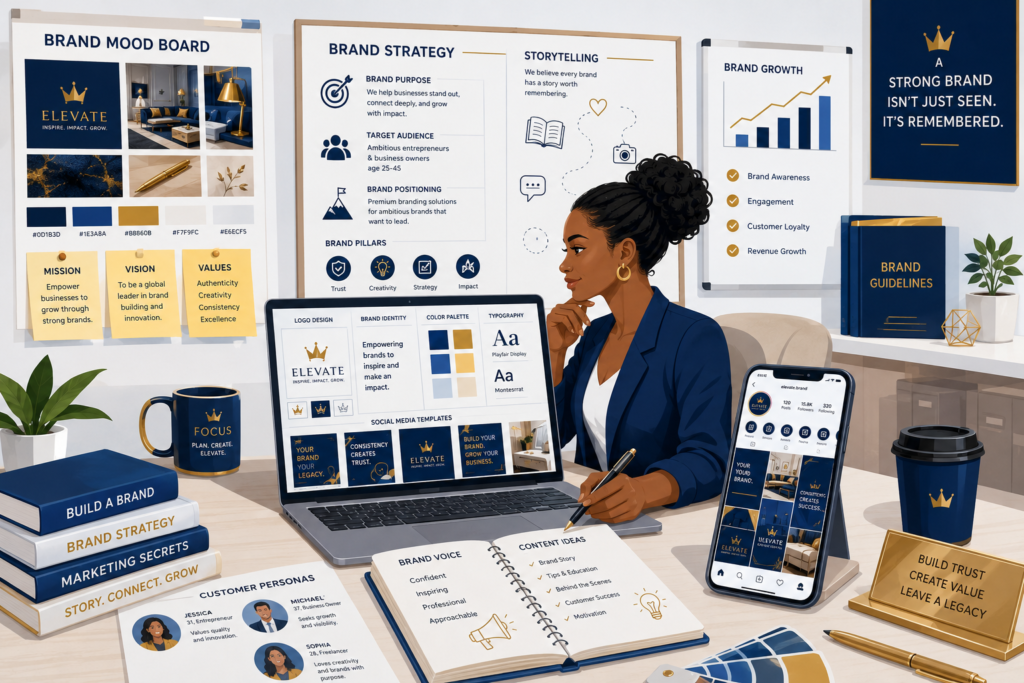
Branding for Business: How to Build a Strong Brand People Remember (Complete Beginner’s Guide)
Learn how branding for business works and discover how to build a memorable brand with the right brand identity, strategy, voice, colors, positioning, storytelling, and social media consistency.
How to Build a Strong Brand People Remember
Why do people happily pay more for an iPhone than another smartphone with similar features?
Why can someone recognize Nike from a simple swoosh without reading a single word? And why do travelers often choose Airbnb because it “feels” different from traditional hotels?
The answer isn’t just great products.
It’s great branding.
Many new entrepreneurs believe branding starts and ends with creating a beautiful logo. While a logo is important, it is only one small piece of a much bigger puzzle. Your brand is what people think, feel, and remember whenever they hear your business name.
In today’s competitive marketplace, customers have endless choices. They don’t simply buy products anymore—they buy trust, emotions, experiences, and values. Businesses that invest in strong branding create loyal customers who return repeatedly and recommend them to others.
Whether you’re launching an online business, opening a local store, building a blog, or growing a personal brand, understanding branding for business can be the difference between blending in and standing out.
This complete guide will teach you exactly how to create a memorable brand from scratch—even if you’re starting with zero experience.
Table of Contents
- What Is Branding for Business?
- Brand vs Logo: What’s the Difference?
- Why Branding Matters
- Define Your Target Audience
- Build Your Brand Identity
- Create Your Brand Strategy
- Develop Your Brand Voice
- Choose Brand Colors Wisely
- Brand Positioning
- Tell a Compelling Brand Story
- Social Media Branding
- Stay Consistent Everywhere
- Real-World Branding Examples
- Common Branding Mistakes
- Actionable Branding Tips
- Frequently Asked Questions
- Final Thoughts
What Is Branding for Business?
Branding for business is the process of creating a unique identity that helps customers recognize, trust, and remember your company.
Your brand includes:
- Your mission
- Your values
- Your personality
- Your customer experience
- Your messaging
- Your visuals
- Your reputation
Think of your brand as your business’s personality.
Just as people remember individuals because of their personality, businesses become memorable because of consistent branding.
Good branding creates emotional connections that influence purchasing decisions.
Brand vs Logo: What’s the Difference?
One of the biggest misconceptions is believing a logo equals a brand.
Here’s the difference.
| Brand | Logo |
| Entire customer perception | Visual symbol |
| Includes emotions | Graphic design |
| Builds trust | Creates recognition |
| Includes messaging | Represents the company visually |
| Long-term experience | One design element |
Imagine meeting someone.
Their face is like the logo.
Their personality, values, communication style, and reputation make up their brand.
The same principle applies to businesses.
A beautiful logo cannot compensate for poor customer service or inconsistent messaging.
Why Branding Matters
Strong business branding provides numerous advantages.
1. Builds Trust
People buy from businesses they trust.
Professional branding instantly increases credibility.
2. Increases Recognition
Customers remember consistent brands.
The more recognizable your business becomes, the easier future sales become.
3. Creates Customer Loyalty
People often become emotionally attached to brands.
Loyal customers:
- Buy repeatedly
- Recommend friends
- Leave positive reviews
- Spend more over time
4. Supports Higher Pricing
Strong brands rarely compete on price.
Instead, they compete on value.
That’s why premium brands charge significantly more than competitors.
Step 1: Define Your Target Audience
Before creating colors, logos, or websites, answer one question:
Who are you serving?
Trying to appeal to everyone usually attracts no one.
Understand your ideal customer by identifying:
- Age
- Gender
- Income
- Interests
- Goals
- Problems
- Buying habits
- Preferred social media platforms
Example
Instead of targeting:
“Everyone who likes fitness.”
Target:
“Busy women aged 25–40 who want quick home workouts after work.”
Specific branding creates stronger connections.
Step 2: Build Your Brand Identity
Your brand identity is everything customers see.
It includes:
- Logo
- Typography
- Colors
- Photography style
- Icons
- Packaging
- Website design
- Social media graphics
Every visual element should feel connected.
A luxury brand looks very different from a children’s toy company.
Your visuals should match your audience’s expectations.
Step 3: Create a Strong Brand Strategy
Your brand strategy defines where your business is going.
It answers important questions like:
- Why does your business exist?
- What problem do you solve?
- What makes you different?
- What values guide your business?
- How should customers feel?
Without strategy, branding becomes random.
A good strategy guides every marketing decision.
Step 4: Develop Your Brand Voice
Brand voice is how your business communicates.
Ask yourself:
Are you:
- Professional?
- Friendly?
- Funny?
- Inspirational?
- Luxurious?
- Casual?
- Educational?
Choose one consistent personality.
Example
A law firm might sound:
Professional
Confident
Authoritative
A gaming company may sound:
Energetic
Fun
Playful
Every email, social media caption, advertisement, and website page should reflect that same voice.
Step 5: Choose Brand Colors Carefully
Colors influence emotions.
Here’s a simple guide.
| Color | Common Meaning |
| Blue | Trust, professionalism |
| Red | Energy, passion |
| Green | Growth, health |
| Yellow | Happiness, optimism |
| Purple | Luxury, creativity |
| Black | Sophistication |
| Orange | Enthusiasm |
| White | Simplicity |
Choose:
- 1 primary color
- 2–3 supporting colors
- Neutral colors for balance
Keep them consistent everywhere.
Step 6: Position Your Brand
Brand positioning explains why customers should choose you over competitors.
Ask:
“What unique value do we offer?”
Strong positioning focuses on benefits—not features.
Weak Positioning
“We sell shoes.”
Strong Positioning
“We create lightweight running shoes designed specifically for marathon beginners.”
Specific beats generic.
Step 7: Tell Your Brand Story
Humans remember stories better than advertisements.
People connect with authenticity.
Your story might include:
- Why you started
- Challenges you overcame
- Your mission
- Customers you’ve helped
- Your vision
Stories create emotional connections.
Customers remember emotions more than product specifications.
Real-World Example
Imagine a bakery.
Instead of saying:
“We bake bread.”
Say:
“Our grandmother taught us family recipes passed down through three generations, inspiring us to create fresh bread that brings families together every morning.”
The second version is memorable.
Step 8: Build Strong Social Media Branding
Social media is often the first place customers discover your business.
Your profiles should immediately communicate who you are.
Keep your branding consistent by using:
- Same profile picture
- Same logo
- Same colors
- Similar fonts
- Consistent captions
- Matching visual style
Avoid posting random content unrelated to your brand.
Every post should reinforce your identity.
Step 9: Be Consistent
Consistency is what transforms businesses into recognizable brands.
Use the same:
- Logo
- Colors
- Fonts
- Tone
- Messaging
- Customer experience
- Email style
- Website design
Customers should instantly recognize your content—even before seeing your logo.
Consistency builds familiarity.
Familiarity builds trust.
Trust builds sales.
Real-World Branding Examples
Apple
Apple sells innovation, simplicity, and premium experiences—not just electronics.
Brand strengths include:
- Minimalist design
- Clean packaging
- Consistent messaging
- Premium pricing
- Exceptional customer experience
Customers associate Apple with innovation and quality.
Nike
Nike doesn’t simply sell shoes.
It sells determination.
Its famous slogan:
“Just Do It.”
Communicates motivation rather than products.
Nike consistently tells stories of athletes overcoming challenges.
The emotional connection strengthens customer loyalty.
Airbnb
Airbnb transformed travel by focusing on belonging rather than accommodation.
Instead of saying:
“Book a room.”
Its branding emphasizes:
“Belong Anywhere.”
This emotional positioning helped differentiate it from traditional hotels.
Common Branding Mistakes
Many businesses damage their brand without realizing it.
Avoid these mistakes.
1. Copying Competitors
Inspiration is fine.
Copying is forgettable.
Develop your own identity.
2. Changing Branding Constantly
Frequent logo, color, or messaging changes confuse customers.
Consistency wins.
3. Ignoring Customer Experience
Excellent branding cannot overcome poor service.
Every customer interaction affects your brand.
4. Trying to Please Everyone
Strong brands serve specific audiences.
Generic branding rarely creates loyal fans.
5. Inconsistent Social Media
Using different logos, colors, or messaging across platforms weakens recognition.
6. No Brand Guidelines
Without guidelines, branding becomes inconsistent as your business grows.
Create simple rules covering:
- Colors
- Fonts
- Voice
- Logo usage
- Image style
Comparison Table: Strong Branding vs Weak Branding
| Strong Branding | Weak Branding |
| Clear identity | Confusing identity |
| Consistent visuals | Different styles everywhere |
| Recognizable voice | Random messaging |
| Defined audience | Targets everyone |
| Emotional connection | Product-focused only |
| Clear positioning | No differentiation |
| Customer loyalty | One-time buyers |
| Professional appearance | Inconsistent experience |
Actionable Tips to Build a Memorable Brand
Define one clear mission.
Know exactly why your business exists.
Understand your audience deeply.
Interview customers.
Read reviews.
Join online communities.
Create brand guidelines.
Document your:
- Colors
- Fonts
- Voice
- Logo usage
- Image style
Tell stories regularly.
Share:
- Behind-the-scenes moments
- Customer success stories
- Founder experiences
- Business milestones
Invest in consistency.
Brand recognition develops over months and years—not days.
Focus on trust before sales.
Helpful content builds stronger brands than endless promotions.
Deliver great customer experiences.
People remember how businesses make them feel.
Review your branding regularly.
Ensure every customer touchpoint reflects your values and mission.
Frequently Asked Questions
What is branding for business?
Branding for business is the process of creating a memorable identity through visuals, messaging, values, customer experiences, and consistent communication.
Is branding only for large companies?
No.
Small businesses often benefit even more because strong branding helps them compete against larger competitors.
Can I build a brand without a logo?
Yes.
While a logo is important, customers remember experiences, trust, service, and consistency more than a graphic.
How long does branding take?
Building a recognizable brand typically takes months or years of consistent effort.
Brand recognition grows gradually.
Should my personal brand match my business brand?
If you’re the face of the company—such as a coach, consultant, influencer, or freelancer—aligning your personal branding with your business branding creates authenticity and trust. Your values, expertise, and communication style should reinforce the business, even if the visual identity differs slightly.
How often should I rebrand?
Only when necessary.
Businesses usually rebrand because:
- Their audience changes.
- They expand into new markets.
- Their current branding no longer reflects their mission.
- Their visual identity has become outdated.
Minor updates are often better than complete redesigns.
Conclusion
Building a memorable brand isn’t about designing the perfect logo or choosing trendy colors. It’s about creating an experience that customers recognize, trust, and want to return to. Every interaction—from your website and social media posts to your customer service and product quality—shapes how people perceive your business.
The strongest brands have a clear purpose, understand their audience, communicate with a consistent voice, and tell stories that resonate. They don’t try to appeal to everyone; instead, they focus on serving the right people exceptionally well. That’s why companies like Apple, Nike, and Airbnb have become household names—they’ve built emotional connections, not just customer lists.
As you develop your own brand, remember that consistency is more valuable than perfection. Start with a clear strategy, define your identity, choose visuals that reflect your values, and deliver on the promises you make. Over time, these small, intentional actions will create recognition, loyalty, and trust.
Ultimately, branding for business is a long-term investment. While advertising may attract attention, a strong brand earns lasting relationships. If you consistently provide value and stay true to your identity, your business won’t just be remembered—it will become the first choice for the customers you want to serve.
How to Write a Business Plan That Actually Works (Step-by-Step Guide for Beginners in 2026)
