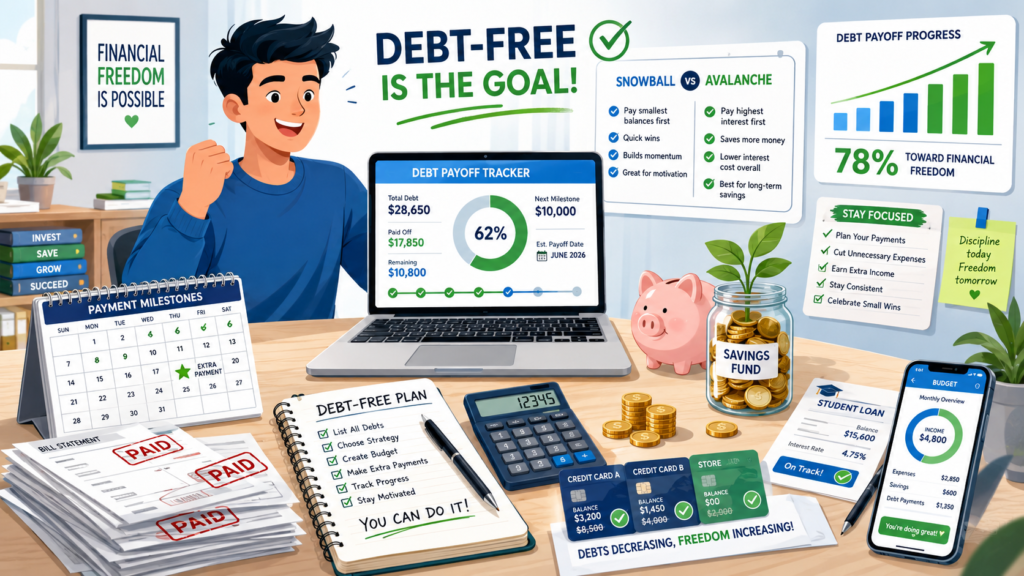
How to Pay Off Debt Faster Without Feeling Overwhelmed: A Complete Beginner’s Guide
Learn how to pay off debt faster without sacrificing your lifestyle. Discover the Snowball and Avalanche methods, smart repayment strategies, motivation tips, and practical examples to become debt-free sooner.
How to Pay Off Debt Faster Without Feeling Overwhelmed
Debt can feel like a heavy weight on your shoulders.
Every month, bills arrive, interest keeps adding up, and it may seem like no matter how much you pay, your balances barely decrease.
Whether it’s credit card debt, student loans, personal loans, or medical bills, being in debt can cause stress, anxiety, and uncertainty about the future.
The encouraging news is that paying off debt doesn’t have to mean giving up everything you enjoy or living an extremely restrictive lifestyle. Thousands of people have successfully become debt-free by following a realistic plan, making consistent progress, and staying motivated over time.
The biggest mistake many people make is trying to pay off all their debt as quickly as possible without a strategy. They cut every expense, work themselves to exhaustion, and eventually lose motivation because the process feels impossible.
Instead, the goal should be to create a repayment plan that is both effective and sustainable.
Imagine waking up without worrying about credit card bills, having money available for emergencies, investing for your future, or taking a vacation without relying on borrowed money. Financial freedom begins with one small step taken consistently.
In this guide, you’ll learn proven methods to eliminate debt faster, understand the difference between the Snowball and Avalanche methods, discover strategies for paying off credit cards and student loans, find creative ways to make extra payments, and learn how to stay motivated until you become completely debt-free.
Table of Contents
- Why Paying Off Debt Matters
- Understanding Good Debt vs. Bad Debt
- Know Exactly What You Owe
- Set a Clear Debt-Free Goal
- The Debt Snowball Method
- The Debt Avalanche Method
- Snowball vs. Avalanche: Which Is Better?
- Paying Off Credit Card Debt Faster
- Student Loan Repayment Strategies
- Smart Extra Payment Strategies
- How to Stay Motivated During Your Debt-Free Journey
- Real-World Examples
- Frequently Asked Questions
- Conclusion
Why Paying Off Debt Matters
Debt affects far more than your bank account. It can influence your mental health, relationships, career choices, and long-term financial goals.
When a large portion of your income goes toward loan repayments, you have less money available for savings, investing, travel, education, or unexpected emergencies. High-interest debt can also keep you trapped in a cycle where you continue paying for years without making significant progress.
Paying off debt provides benefits that extend beyond finances, including:
- Reduced financial stress
- Better credit health
- Increased monthly cash flow
- Greater financial security
- More opportunities to invest and build wealth
- Peace of mind knowing your income belongs to you
The sooner you eliminate unnecessary debt, the sooner you can focus on achieving other financial goals.
Understanding Good Debt vs. Bad Debt
Not every type of debt is harmful. Understanding the difference helps you prioritize which debts should be paid off first.
| Good Debt | Bad Debt |
| Student loans that increase earning potential | High-interest credit card debt |
| Affordable home mortgage | Payday loans |
| Business loans that generate income | Impulse shopping financed with credit |
| Investment property loans | Buy Now, Pay Later overspending |
Good debt generally helps you build wealth or increase future income.
Bad debt usually finances depreciating items while charging high interest.
For example, taking out a student loan to earn a degree that significantly increases your income may provide long-term financial benefits.
On the other hand, carrying a large credit card balance to purchase luxury items often leads to years of expensive interest payments.
When creating your repayment plan, focus on eliminating high-interest debt first whenever possible.
Know Exactly What You Owe
One of the biggest reasons people feel overwhelmed is that they don’t have a complete picture of their debt.
Before making any repayment strategy, list every debt you currently owe.
Include:
- Creditor name
- Remaining balance
- Interest rate
- Minimum monthly payment
- Due date
- Loan term
Example Debt List
| Debt | Balance | Interest Rate | Minimum Payment |
| Credit Card A | $4,000 | 24% | $120 |
| Credit Card B | $2,500 | 18% | $75 |
| Student Loan | $18,000 | 5% | $180 |
| Personal Loan | $6,000 | 9% | $150 |
This simple exercise helps you identify which debts are costing you the most money and where your repayment efforts should begin.
Although seeing all your debts at once may seem intimidating, clarity is the first step toward becoming debt-free.
Set a Clear Debt-Free Goal
A specific goal is much easier to achieve than a vague one.
Instead of saying:
“I want to get out of debt someday.”
Set measurable goals such as:
- Pay off my first credit card within six months.
- Eliminate all high-interest debt within two years.
- Become completely debt-free before buying a house.
- Reduce my total debt by 50% this year.
Breaking your journey into smaller milestones helps you stay motivated.
For example:
✔ Pay off the first $1,000
✔ Eliminate your first credit card
✔ Reach the halfway point
✔ Pay off your final loan
Each milestone reminds you that progress is happening, even if it feels slow.
The Debt Snowball Method
The Debt Snowball Method is one of the most popular debt repayment strategies because it focuses on motivation.
Instead of paying off the debt with the highest interest rate first, you begin by paying off the smallest balance.
How the Snowball Method Works
- Continue making the minimum payment on every debt.
- Put every extra dollar toward the smallest balance.
- Once the smallest debt is paid off, roll that payment into the next smallest debt.
- Repeat the process until all debts are eliminated.
Example
| Debt | Balance |
| Credit Card A | $800 |
| Credit Card B | $2,500 |
| Personal Loan | $7,000 |
| Student Loan | $18,000 |
In this example, you would focus all extra payments on the $800 credit card first.
After it’s paid off, you take the money you were using for that payment and add it to the payment for the $2,500 debt.
As each debt disappears, your available payment grows larger—just like a snowball rolling downhill.
Advantages of the Snowball Method
- Quick wins keep you motivated.
- Simplifies your repayment plan.
- Builds confidence.
- Encourages long-term consistency.
- Helps many people stick to their financial goals.
Disadvantages
- You may pay more interest overall.
- It isn’t always the fastest method mathematically.
- High-interest debts may remain longer.
Even so, many financial experts agree that a strategy you consistently follow is often better than the “perfect” strategy you abandon after a few months.
The Debt Avalanche Method
If your primary goal is to save as much money as possible on interest, the Debt Avalanche Method is often the best strategy. Unlike the Snowball Method, which focuses on paying off the smallest balance first, the Avalanche Method targets the debt with the highest interest rate.
Although it may take longer to experience your first payoff, you’ll usually spend less money overall because you’re reducing the most expensive debt first.
How the Debt Avalanche Method Works
The process is simple:
- Continue making the minimum payment on every debt.
- Put any extra money toward the debt with the highest interest rate.
- Once that debt is paid off, move to the debt with the next-highest interest rate.
- Repeat until every debt is eliminated.
Example
Imagine you have the following debts:
| Debt | Balance | Interest Rate |
| Credit Card A | $3,000 | 26% |
| Credit Card B | $2,500 | 19% |
| Personal Loan | $8,000 | 10% |
| Student Loan | $18,000 | 5% |
Using the Avalanche Method, you would focus on Credit Card A first because it has the highest interest rate, even though it isn’t the smallest balance.
After paying it off, you would move to Credit Card B, then the Personal Loan, and finally the Student Loan.
Advantages of the Avalanche Method
- Saves the most money on interest.
- Helps you become debt-free at the lowest overall cost.
- Ideal for people with several high-interest debts.
- Makes financial sense over the long term.
Disadvantages
- It may take longer before you eliminate your first debt.
- Progress can feel slower if your highest-interest debt also has the largest balance.
- Some people lose motivation before seeing results.
If you’re disciplined and motivated by saving money, the Avalanche Method is an excellent choice.
Snowball vs. Avalanche: Which Method Is Better?
Both strategies are effective, but the best one depends on your personality and financial goals.
| Feature | Snowball Method | Avalanche Method |
| Focus | Smallest balance first | Highest interest rate first |
| Motivation | High | Moderate |
| Interest Savings | Lower | Higher |
| Quick Wins | Yes | Usually No |
| Best For | People who need motivation | People focused on saving money |
Choose the Snowball Method if:
- You want quick victories.
- You often lose motivation.
- You have several small debts.
- Seeing progress keeps you committed.
Choose the Avalanche Method if:
- Saving money is your top priority.
- You’re comfortable waiting longer for your first payoff.
- You have high-interest credit card debt.
- You can stay disciplined over the long term.
Can You Combine Both Methods?
Absolutely.
Many people start with the Snowball Method to build momentum by paying off one or two small debts. Once they feel more confident, they switch to the Avalanche Method to reduce interest costs.
The best repayment strategy is the one you’ll consistently follow.
How to Pay Off Credit Card Debt Faster
Credit card debt is one of the most expensive forms of debt because interest rates are often much higher than student loans, car loans, or mortgages.
If you only make the minimum payment each month, it can take years—or even decades—to pay off a large balance.
1. Stop Adding New Debt
Before focusing on repayment, stop increasing your balance.
Consider:
- Using cash for everyday purchases.
- Leaving your credit cards at home.
- Removing saved card details from online shopping accounts.
- Avoiding impulse purchases.
Every new charge slows your progress.
2. Pay More Than the Minimum
Minimum payments mainly cover interest, leaving very little to reduce the principal.
Even an extra $25 or $50 each month can shorten your repayment timeline significantly.
For example:
- Minimum payment: $100
- Extra payment: $50
- Total monthly payment: $150
That additional $50 goes directly toward reducing your balance faster.
3. Make Multiple Payments Each Month
Instead of making one payment every month, divide your payment into two or four smaller payments.
Benefits include:
- Reducing your average daily balance.
- Lowering interest charges.
- Helping you budget more effectively.
4. Transfer High-Interest Balances (If It Makes Sense)
Some financial institutions offer balance transfer cards with promotional 0% interest periods.
If you qualify and pay off the balance before the promotional period ends, you could save a substantial amount in interest.
Be sure to read the terms carefully and avoid accumulating new debt on the original card.
5. Increase Your Monthly Payment Whenever Your Income Increases
Whenever you receive:
- A salary raise
- Freelance income
- A bonus
- Tax refunds
- Birthday money
- Cash gifts
Consider putting at least part of it toward your credit card balance.
Small one-time payments can make a noticeable difference over time.
Strategies for Paying Off Student Loans
Student loans usually have lower interest rates than credit cards, but they can still take many years to repay.
Here are practical ways to reduce them faster.
Pay More Than the Required Amount
Even an additional payment of $50 per month can reduce the total interest paid and shorten the repayment period.
Always confirm that extra payments are applied to the principal rather than future scheduled payments.
Continue Living Like a Student for a While
If you’ve recently graduated or received a higher-paying job, avoid increasing your lifestyle immediately.
Instead of upgrading everything at once, continue living modestly for another year or two and direct the extra income toward your loans.
This temporary sacrifice can save thousands of dollars in interest.
Use Windfalls Wisely
Unexpected money can accelerate your debt payoff.
Examples include:
- Work bonuses
- Tax refunds
- Inheritance
- Side hustle income
- Cashback rewards
Rather than spending the entire amount, consider applying a large portion to your student loan balance.
Refinance Only When It Makes Financial Sense
Some borrowers qualify for lower interest rates through refinancing.
However, refinancing isn’t the right choice for everyone—especially if it means giving up valuable borrower protections or flexible repayment options.
Compare lenders carefully before making a decision.
Avoid Missing Payments
Late payments can lead to:
- Additional fees
- Damage to your credit score
- Higher borrowing costs in the future
Setting up automatic payments or calendar reminders can help you stay on track.
By combining consistent payments with smart financial habits, you’ll gradually reduce both your credit card debt and student loans while building confidence in your financial future.
Extra Payment Strategies That Can Save You Thousands
One of the fastest ways to become debt-free is to make extra payments whenever possible. Even small additional payments can significantly reduce the amount of interest you pay over the life of your loans.
The key isn’t necessarily earning a huge income—it’s consistently finding opportunities to pay a little more than the minimum.
Here are some of the most effective strategies.
Round Up Your Monthly Payments
Instead of paying the exact minimum payment, round it up.
For example:
- Minimum payment: $183
- Pay: $200
That extra $17 may not seem like much, but over the course of a year, it adds up to more than $200 in additional principal payments.
This simple habit can shave months off your repayment schedule.
Make Biweekly Payments
Rather than making one monthly payment, divide it into two smaller payments every two weeks.
For example:
- Monthly payment: $400
- Biweekly payment: $200
Since there are 52 weeks in a year, you’ll end up making the equivalent of 13 monthly payments instead of 12, helping you pay off your debt faster without feeling a major difference in your budget.
Use Windfalls to Reduce Debt
Whenever you receive unexpected money, consider putting at least part of it toward your debt.
Examples include:
- Tax refunds
- Work bonuses
- Overtime pay
- Freelance income
- Cashback rewards
- Birthday or holiday cash gifts
- Profit from selling unwanted items
You don’t have to use all of it. Even applying 50% toward your debt can make a meaningful difference.
Start a Side Hustle
A temporary side hustle can dramatically speed up your debt repayment.
Some ideas include:
- Freelance writing
- Graphic design
- Virtual assistance
- Food delivery
- Ride-sharing
- Selling handmade products
- Tutoring
- Pet sitting
- Online surveys (for small extra income)
- Selling digital products
If you earn an extra $300 per month and dedicate it entirely to debt, that’s $3,600 toward your balances in one year.
Cut Expenses Without Feeling Deprived
Paying off debt doesn’t mean eliminating every enjoyable expense.
Instead, focus on reducing costs that don’t add much value to your life.
Consider:
- Canceling unused subscriptions.
- Cooking at home more often.
- Negotiating lower insurance rates.
- Comparing utility providers.
- Buying quality second-hand items.
- Using public transportation when practical.
- Shopping with a grocery list.
The goal is to redirect those savings toward debt repayment—not to make yourself miserable.
Ways to Find Extra Money Every Month
Many people believe they don’t earn enough to make extra debt payments.
However, small changes can free up more money than you might expect.
Here are a few practical ideas:
Review Your Monthly Budget
Look for categories where you’re consistently overspending.
Examples:
- Dining out
- Entertainment
- Online shopping
- Subscription services
- Food delivery
- Impulse purchases
Even reducing these expenses by a modest amount can create room for extra debt payments.
Sell Items You No Longer Use
Many households have valuable items collecting dust.
You could sell:
- Old electronics
- Clothing
- Furniture
- Sports equipment
- Gaming consoles
- Books
- Baby items
- Collectibles
The money can immediately reduce one of your debt balances.
Automate Savings Into Debt Payments
If you normally save a certain amount each month while carrying high-interest credit card debt, consider directing some of those funds toward repayment instead.
Once your expensive debt is gone, you can redirect that money back into savings and investing.
Common Mistakes That Slow Down Debt Repayment
Avoiding these mistakes can save both time and money.
Only Paying the Minimum
Minimum payments often cover mostly interest, making progress painfully slow.
Whenever possible, pay more than the required minimum.
Continuing to Use Credit Cards
Paying off debt while continuing to accumulate new balances is like trying to fill a bucket with a hole in the bottom.
If possible, avoid adding new debt until you’re financially stable again.
Ignoring High Interest Rates
High-interest debt becomes increasingly expensive over time.
Understand which debts are costing you the most and create a repayment strategy that addresses them.
Not Having an Emergency Fund
Without emergency savings, unexpected expenses often lead to even more borrowing.
Even saving $500 to $1,000 as a starter emergency fund can prevent future setbacks.
Comparing Yourself to Others
Everyone’s financial journey is different.
Focus on your own progress rather than comparing your debt payoff timeline with someone else’s.
Consistency matters more than speed.
How to Stay Motivated During Your Debt-Free Journey
Paying off debt is a marathon, not a sprint.
Staying motivated is just as important as choosing the right repayment strategy.
Celebrate Small Wins
Every milestone deserves recognition.
Examples include:
- Paying off your first debt.
- Reducing your balance below a certain amount.
- Completing six months of consistent payments.
- Reaching the halfway point.
Your celebration doesn’t have to be expensive. Enjoy a favorite meal, watch a movie, or spend time with loved ones.
Track Your Progress
Watching your balances decrease provides powerful motivation.
You can use:
- A budgeting app
- A spreadsheet
- A printable debt tracker
- A notebook
- A wall chart
Seeing visual progress reminds you that your efforts are paying off.
Remember Your “Why”
Ask yourself:
- Why do I want to become debt-free?
- What opportunities will open once my debt is gone?
- How will my life improve?
Your reason might be:
- Buying a home
- Traveling
- Starting a business
- Saving for retirement
- Supporting your family
- Reducing financial stress
Keep your “why” somewhere visible to stay focused.
Don’t Let Setbacks Stop You
Unexpected expenses happen.
Missing one extra payment or facing a financial emergency doesn’t mean you’ve failed.
The important thing is to restart as soon as possible.
Progress—not perfection—is what leads to financial freedom.
Real-World Examples
Example 1: Paying Off Credit Card Debt
Sarah owed $8,000 across three credit cards.
She chose the Debt Snowball Method, paying off her smallest balance first.
Each time she eliminated a card, she rolled that payment into the next one.
Within 30 months, she became completely credit card debt-free.
The quick wins helped her stay motivated throughout the process.
Example 2: Saving Money with the Avalanche Method
James had:
- Two credit cards
- A personal loan
- A car loan
He focused on paying off the highest-interest credit card first.
Although it took almost a year to eliminate his first balance, he ultimately saved over $2,000 in interest compared to making minimum payments.
Example 3: Using Extra Income
Maria started freelancing on weekends and earned an additional $400 per month.
Instead of increasing her spending, she used every extra dollar to repay her student loan.
She finished paying it off nearly three years earlier than originally scheduled.
Frequently Asked Questions
Which debt should I pay off first?
If motivation is your biggest challenge, the Snowball Method can help you build momentum by paying off the smallest balance first.
If saving money on interest is your priority, the Avalanche Method is usually the better choice.
Should I save money or pay off debt first?
Ideally, build a small emergency fund before aggressively paying off high-interest debt. This can help you avoid borrowing again when unexpected expenses arise.
Is it better to make one large payment or several smaller payments?
As long as your lender applies the payments to your principal balance, either approach can work. Multiple payments throughout the month may help reduce interest on some types of debt.
How long does it usually take to become debt-free?
The timeline depends on your income, expenses, interest rates, and repayment strategy. Some people eliminate debt within a year, while others may take several years. Consistency is more important than speed.
Can I pay off debt while investing?
If you have high-interest debt, paying it off is often a higher priority. Once expensive debt is under control, you can increase your investments while continuing to build long-term wealth.
Conclusion
Paying off debt isn’t about finding a secret shortcut—it’s about making consistent, intentional choices every month.
Whether you choose the Debt Snowball Method for quick motivation or the Debt Avalanche Methodto save more on interest, the most important step is simply getting started.
Remember that every extra payment, every smart financial decision, and every small milestone brings you closer to financial freedom.
There will be challenges along the way, but setbacks don’t erase your progress. Stay focused on your long-term goals, celebrate every victory, and keep reminding yourself why becoming debt-free matters.
Financial freedom doesn’t happen overnight, but with patience, discipline, and a clear plan, it’s absolutely achievable.
The journey may begin with a single payment, but it ends with greater peace of mind, stronger financial security, and the freedom to use your money to build the life you truly want.
How to Build Your First Emergency Fund: A Beginner’s Step-by-Step Plan
How to Create a Budget That Actually Works (Even If You’ve Failed Before): A Complete Beginner’s Guide for 2026
Personal Finance for Beginners: A Step-by-Step Guide to Managing Your Money in 2026
